
The short answer
Vibe-coding tools like Lovable, Replit, and Bolt build a working demo fast — that's real and valuable. The hard part is the last 30%: security, tests, record-level permissions, and multi-account isolation, which demos skip. For the system you run your business on, use AI to build your workspace on a maintained platform, not to generate a codebase you then babysit.
You typed a sentence. Ninety seconds later a working app blinked back at you — login, dashboard, a table you could actually add rows to. It felt like magic because it *is* a kind of magic. The prompt-to-app tools have earned their moment.
So this article isn't a takedown. Lovable, Replit, and Bolt are genuinely good at the thing they were built for. The honest question — the one that decides whether you're happy in eighteen months — is narrower: *what carries a demo into a system your business actually runs on?*
What are vibe-coding tools actually great at?
Speed from idea to a clickable, deployed thing — with no setup and no team. That's real. Each tool has a genuine sweet spot, and for prototypes, internal tools, and validating an idea before you spend, they are excellent. The trouble only starts when a prototype is quietly promoted to a production system without anyone deciding to.
| Tool | Genuinely best at | Honest price (mid-2026) |
|---|---|---|
| Replit + Agent | Idea to a live URL in one place — build, host, deploy, zero setup | Free tier; Core ~$25/mo; Agent credits are usage-based — a real app can burn $30-50+ |
| Lovable | Most beginner-friendly, best-looking output; auto-provisions a backend | From ~$25/mo, credit-based; opinionated, so less flexible off the path |
| Bolt | See and edit every file in the browser — developer control and speed | ~$25/mo, token-based |
| v0 | The best UI and component generation, hands down | Free $5/mo; Plus ~$20-30/mo — front-end-focused, weaker on backend/auth/DB |
| Cursor | Accelerating a real codebase for professional developers | Pro $20/mo — an assistant for engineers, not a no-code builder |
So what does the demo quietly skip?

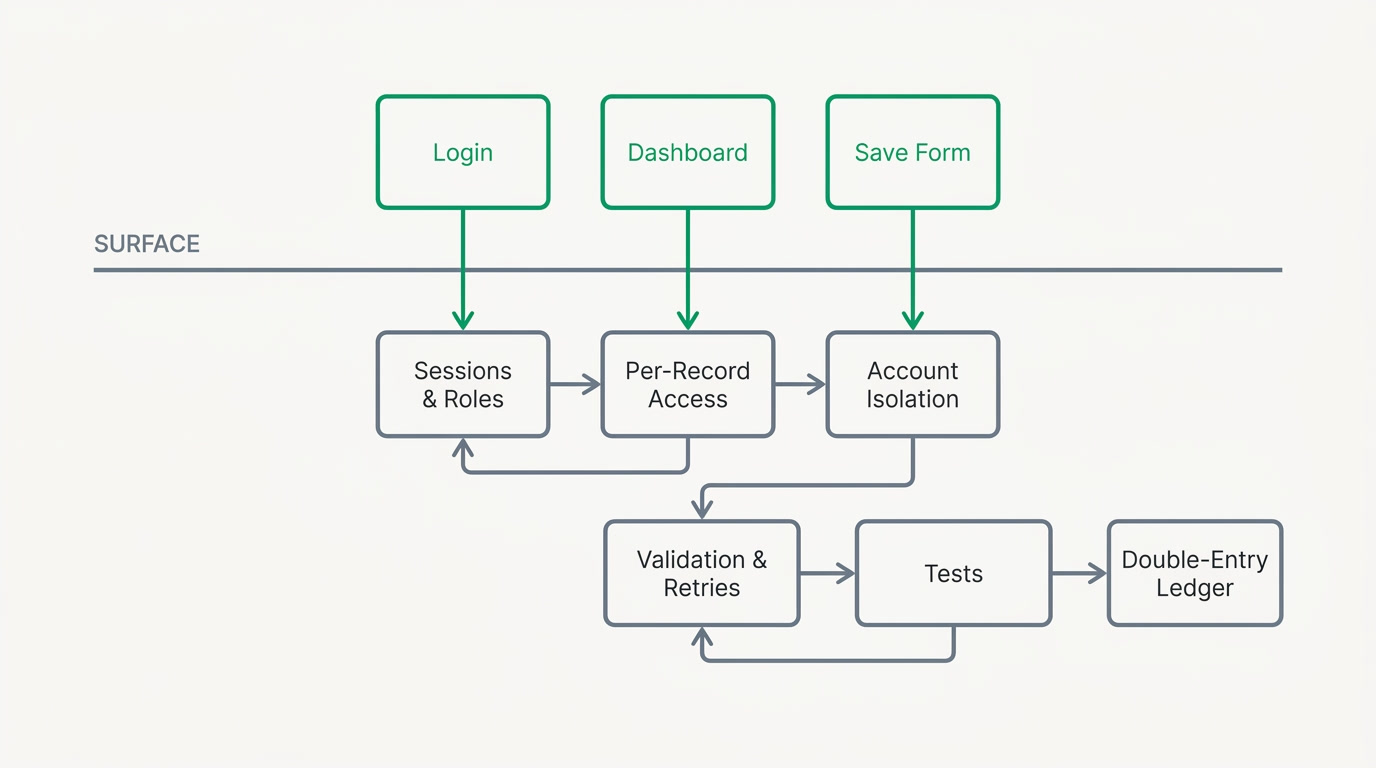
The unglamorous 30% that separates "it works on my screen" from "it holds up when strangers, edge cases, and real money arrive." A demo proves the happy path. Production is almost entirely the *unhappy* paths — the double-submitted form, the deleted record someone still links to, the user who shouldn't see that invoice.
| A demo shows you | Production actually needs |
|---|---|
| A login screen | Sessions, password resets, and roles that hold under attack |
| "This user can edit records" | "Can this user edit THIS record" — the hard, per-record question |
| One account's data | Strict separation so no account can ever see another's |
| A form that saves | Validation, error handling, and what happens on the 12th retry |
| A working screen today | Tests, so the next AI edit doesn't silently break it |
| A ledger that adds up on screen | Real double-entry that stays balanced through refunds, edits, and time |
Is the generated code actually safe to run a business on?
Often not yet, and the industry is measuring it. Veracode's 2025 research found roughly 45% of AI-generated code introduced an OWASP Top-10 vulnerability (over 70% in some languages). AI-assisted developers ship far faster but generate security findings at many times the rate — a pile the field now calls "security debt."
The pattern under it: AI scaffolds rarely ship tests, and the parts it does naively are exactly the parts that matter most — auth, roles, and the per-record permission question. "Can this user touch this specific record?" is genuinely hard, fails *open* when you get it wrong (it just lets people in), and almost never shows up in a demo. Separating one account's data from another's is the same story: invisible until the day it isn't.
The 70% problem
AI gets you ~70% of the way fast. The last 30% — edge cases, error handling, security, performance, integration — is the slow, expensive part, and it doesn't get faster the second time. Harness's 2025 delivery research found teams now spend *more* time debugging AI-written code and fixing its vulnerabilities than they save writing it.
What breaks as a vibe-coded app grows?
Two things quietly compound. First, invisible technical debt: scaffolded code accumulates structure nobody understands, because nobody wrote it — they prompted it. Second, regeneration drift: you re-prompt to add a feature, and the model silently rewrites working code you'd forgotten was load-bearing. The fix looks clean; the thing it broke surfaces three weeks later.
This is why a new role appeared in late 2025 — the "vibe-coding cleanup specialist," hired to make generated apps maintainable after the fact. That role is the market pricing the last 30% out loud. It's not a knock on the tools; it's what happens when a prototype gets a promotion it was never designed for.
So should you build it, or run on something already built?
For a throwaway prototype, an internal tool, or testing an idea — build it, and enjoy the speed. For the system your business runs on — the one holding your customers, your people, and your money — you want AI's speed without owning its maintenance, security, and scale problems. Those are different jobs, and pretending they're the same is where the pain comes from.
That's the line ERPnBox is built on. Its AI builds your *workspace* — the modules, fields, and workflows your operation needs — on top of a platform where the hard 30% is already engineered and maintained: real auth, per-record permissions, strict account separation, and a genuine double-entry ledger. You get the minutes-not-months speed, and you never inherit the codebase you'd otherwise have to babysit. ERPnBox is the opposite of a vibe-coded app: it's the maintained thing you build on, not the generated thing you patch.
The right question was never "can AI build it?" It's "who maintains it at 2 a.m. eighteen months from now?"
Build your workspace, skip the codebase
Describe your business in plain language and watch it become a working CRM, HR, and Finance in minutes — on a platform that already handles the hard 30%.
See how the build worksFrequently asked questions
Is Lovable good enough to run a real business on?
[Lovable](https://lovable.dev) is excellent for prototypes, internal tools, and the best-looking first draft you'll get from a prompt — that's real value. The caution is about the **last 30%**: tests, per-record permissions, and account separation that a generated app tends to under-build. For a system holding customers, staff, and money, you either budget for that hardening or run on a platform where it already exists.
What is the 70% problem in AI coding?
AI gets you about 70% of the way to a finished app very fast. The remaining **30% — edge cases, error handling, security, performance, and integration** — is slow, expensive, and doesn't speed up with more prompting. Industry research in 2025 found teams can end up spending more time fixing AI-written code than they saved generating it.
Does ERPnBox generate code I have to maintain?
No. ERPnBox's AI builds your **workspace** — modules, fields, and workflows — as configuration on top of one maintained platform. It does not hand you a codebase. The auth, permissions, account separation, and [double-entry ledger](/finance) are engineered and maintained by us, so you get AI-speed setup without inheriting a system to patch.
When should I use a vibe-coding tool instead of ERPnBox?
When you need a **one-off prototype, a small internal tool, or a custom experience that isn't your core business system** — tools like [Replit](https://replit.com), [Bolt](https://bolt.new), or [v0](https://v0.app) are excellent and fast. ERPnBox is for the operational backbone — CRM, HR, Finance, and connected apps — where maintenance and permissions matter for years, not for a weekend.
Is AI-generated code really less secure?
On average, the measured answer is yes — for now. Veracode's 2025 research found roughly **45% of AI-generated code introduced an OWASP Top-10 vulnerability**, and AI-assisted developers tend to ship security findings at a much higher rate. It's not that the code is worthless; it's that the security work is real work the tool doesn't do for you.