Your books and your deals, in one place
Real double-entry accounting that lives beside your sales team, not in a separate program you reconcile by hand. Every invoice, payment, and expense posts to the ledger the moment it happens.
- True double-entry ledger, not a spreadsheet with totals
- Bill a customer the second the deal closes
- Work in any currency and keep one clean base
- Full Arabic, right to left, from invoice to report
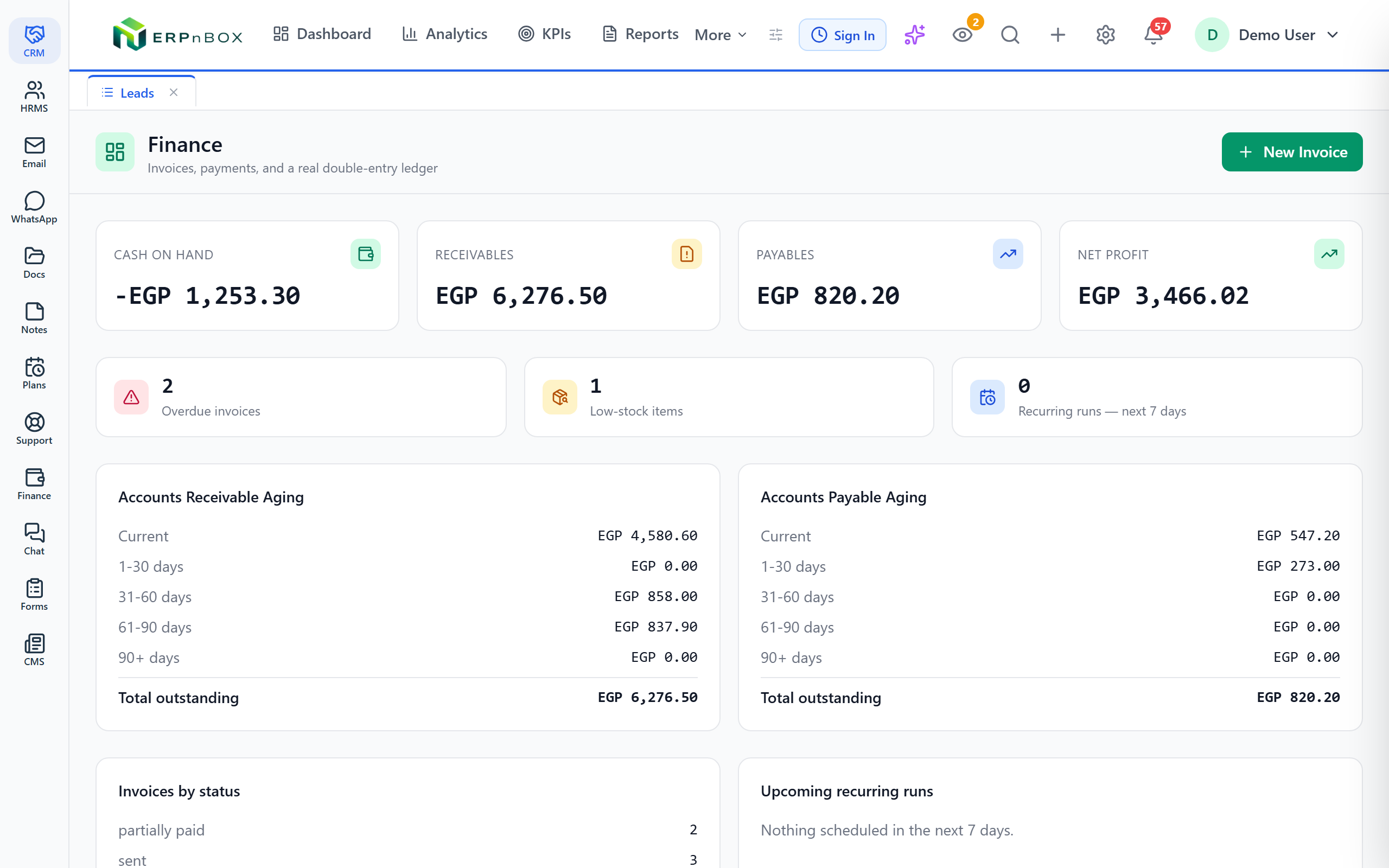
Everything the finance team needs
Seven modules that share the same ledger, the same customers, and the same login.
Finance
Send a clean, correct invoice in under a minute. Quote first, convert with one click, and let the numbers add themselves up.
ExploreGeneral Ledger
A real double-entry general ledger under the same login as your sales. Debits equal credits on every document, posted entries are permanent, and corrections happen the honest way — through reversing entries.
ExplorePayments & Receivables
Record a payment once and split it across every open invoice. Hold advances on account, set credit limits and terms, and let overdue reminders and late fees chase the money for you.
ExploreExpenses & Payables
Enter a vendor bill and it becomes a line you can pay, allocate, dispute, or credit — with budgets that warn or block before the money leaves, and every attachment filed against the vendor who sent it.
ExploreFinance
See profit, cash, receivables and tax the moment you post a transaction. No spreadsheet exports, no month-end scramble, no numbers that disagree with the ledger.
ExploreFinance
Set your VAT rates to the exact fraction, bundle them into compound groups when one rate is never enough, and let every invoice and bill post the right tax to the right account. Input VAT nets against output VAT in the ledger, so you always know what you owe and what you can reclaim.
ExploreFinance
Invoice a customer in dollars, pay a supplier in euros, and let ERPnBox record every gain and loss from a moving exchange rate — automatically, at the moment money actually changes hands.
Explore14
Financial reports
7
Finance sub-modules
1
Login for sales and books
2
Languages, EN + AR
One ledger, no re-typing
When your sales team closes a deal, the invoice, the payment, and the revenue all flow into the same books. There is no export, no import, and no month-end reconciliation between two systems that never quite agree.
Accounting a real accountant trusts
Every transaction posts a balanced journal entry to a proper chart of accounts. Your accountant gets a trial balance, a profit and loss, and a balance sheet that actually tie out, not a report cobbled from a sales spreadsheet.
01
From closed deal to posted invoice
Because your customers live in the same workspace as your books, an invoice starts from the record your sales team already built. Raise it, send it, and it posts to the ledger, all without leaving the app.
02
Multi-currency without the mess
Bill an overseas customer in their currency and pay a supplier in another. Your base currency is locked the moment your first entry is posted, so your reports stay consistent no matter how many currencies you trade in.
03
Tax that follows the transaction
Value-added tax and withholding tax are applied where they belong, on the invoice or the payment, so the amounts your accountant needs are already sitting in the ledger at period end.
Full feature list
Everything that's inside
Core accounting
Double-entry ledger | Every transaction creates a balanced journal entry, the foundation of trustworthy books. |
Chart of accounts | Organise assets, liabilities, revenue, and expenses the way your business is actually structured. |
Cost centres | Attribute income and spend to departments, projects, or branches for sharper reporting. |
Year-end close | Close the books at the end of the period and carry balances forward cleanly. |
Receivables & payables
Customer invoices | Bill customers straight from their record and post the sale to the ledger. |
Payments in and out | Record what customers pay you and what you settle with suppliers. |
Advances | Take money before the invoice and apply it correctly when the bill is raised. |
Write-offs | Clear bad debt from the books with a proper accounting entry. |
Credit limits & terms | Set how much credit a customer gets and when payment is due. |
Currency, tax & reporting
Multi-currency | Trade in many currencies while a single locked base currency keeps reports consistent. |
Value-added tax | Apply VAT on the invoices and purchases that carry it. |
Withholding tax | Handle amounts withheld at source so your ledger reflects the true settlement. |
Deferred revenue | Recognise income across the period it belongs to, not all at once. |
14 financial reports | Trial balance, profit and loss, balance sheet, and more, all from live ledger data. |
Frequently asked questions
Is this real accounting or just invoice totals?
It is real double-entry accounting. Every transaction posts a balanced journal entry to a proper chart of accounts, which is why you get a trial balance, a profit and loss, and a balance sheet that tie out.
Do the finance and sales sides share data?
Yes. Your customers, deals, and books live in the same workspace under one login, so an invoice starts from the record your sales team already built, with no export or import in between.
Can we work in more than one currency?
Yes. You can invoice and pay in any currency. Your base currency is locked once your first entry is posted, which keeps every report consistent no matter how many currencies you trade in.
Does it handle VAT and withholding tax?
Yes. Value-added tax and withholding tax are applied on the invoices and payments that carry them, so the amounts your accountant needs are already in the ledger at period end.
Is the finance side available in Arabic?
Yes. The finance modules work fully in Arabic with proper right-to-left layout, from the invoice a customer receives to the reports your accountant reads.
What reports do we get?
There are 14 financial reports drawn from live ledger data, including the trial balance, profit and loss, and balance sheet, so you can see the true state of the business at any moment.
Run your books on ERPnBox
Real double-entry accounting in the same workspace as your CRM. Start free, no credit card.