
The short answer
Zoho Books is a best-in-class standalone accounting tool with automatic bank feeds across many countries and a free tier under $50k revenue. Choose it if you only need accounting. Choose ERPnBox when you want the ledger to live inside the same platform as your CRM, HR, and other apps, at one per-seat price.
If you only ever need to keep books, this is a short article: Zoho Books is one of the best tools on the market and you should probably use it. It is mature, dedicated accounting software with deep features and international reach. We are not going to pretend otherwise.
But most operators don't have an accounting problem. They have a disconnected-tools problem — a sales system that doesn't know what got invoiced, a payroll spreadsheet that doesn't know the ledger, three logins to answer one question. That's the comparison worth having. So here is the honest version, with Zoho Books' real strengths stated first.
What is Zoho Books genuinely good at?

Zoho Books is dedicated, mature accounting done well. It offers automatic bank feeds across many countries — through Plaid in the US and Canada, Token for UK and EU open banking, Syncfy in Mexico and more — refreshing roughly every 24 hours. It has a free tier for businesses under $50k in annual revenue, deep tax and reporting features, and years of refinement behind it.
As of mid-2026, paid plans start around $15–20/month (Standard) and $50/month (Professional), with bank feeds included on the paid tiers. For a business that wants accounting and only accounting, that combination — coverage, depth, price — is hard to beat, and its accountant-facing tooling is genuinely strong. If that's your need, stop reading and go set it up.
So what is different about ERPnBox Finance?
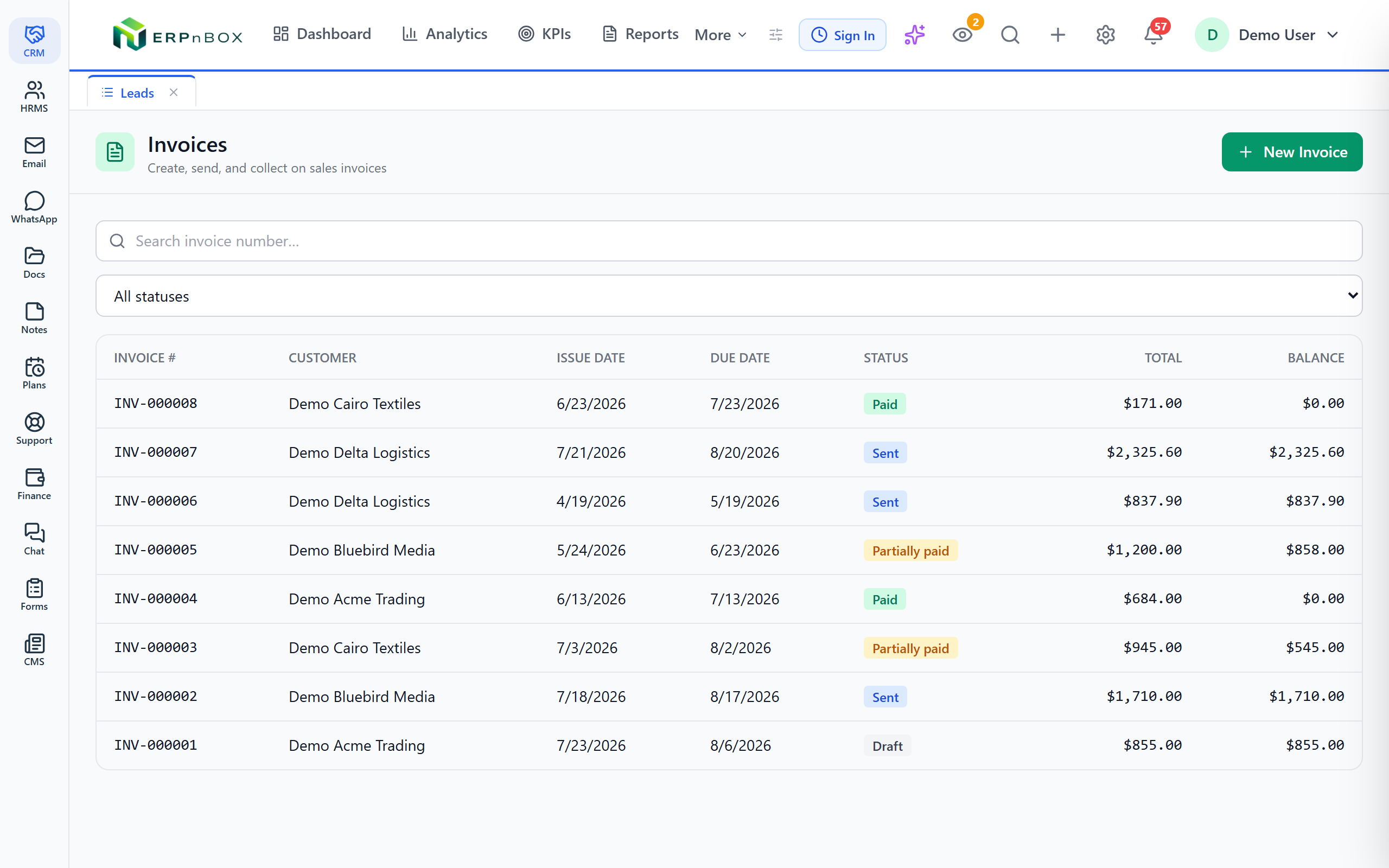
ERPnBox's difference is not "better accounting." It's where the ledger lives. ERPnBox Finance is a real double-entry ledger — invoicing, expenses, reconciliation, multi-currency, tax groups — that sits inside the same platform as your CRM, HR, payroll, and a dozen other apps. One login, one per-seat price, one connected set of records.
That changes what a number *means*. In a standalone tool, an invoice is a row. In ERPnBox, an invoice carries its deal — you can walk from a payment on the ledger back to the salesperson who closed it, the contact who signed, and the payment plan behind it, without exporting anything. Finance stops being a separate book you reconcile against your sales system; the sale and its money are the same thread.
What about bank feeds — the honest version
Here is where fairness matters. ERPnBox Finance now ships live bank feeds via Stripe Financial Connections — you connect your bank inside Stripe's secure modal, we never see your credentials, and transactions flow through the same import, matching, and reconciliation pipeline as a CSV. But the honest limit: Stripe connects US bank accounts (roughly 5,000 US institutions). Businesses in 34 countries can use it, but non-US bank accounts aren't supported yet.
The plain rule on bank feeds
Connect your bank where Stripe supports it, or import a statement anywhere. Zoho Books' feed coverage (Plaid/Token/Syncfy) is broader than ours today — full stop. If automatic feeds in your country are the deciding factor, that's a real point for Zoho.
ERPnBox vs Zoho Books: the full comparison
Prices are as of mid-2026. Read this table for fit, not for a winner — the two tools answer different questions. One is the best answer to "how do I keep my books?" The other is the best answer to "how do I run the whole business from one place?"
| Zoho Books | ERPnBox Finance | |
|---|---|---|
| Core accounting | Dedicated, mature, deep | Real double-entry ledger, invoicing, expenses, tax groups |
| Automatic bank feeds | Broad — Plaid, Token, Syncfy across many countries | Live feeds for US bank accounts via Stripe; statement import anywhere |
| CRM + sales | Separate Zoho apps you wire together | Built in — invoices carry their deal |
| HR + payroll | Separate Zoho products | Same platform, same login |
| Pricing model | Free under $50k/yr; ~$15–20 Standard; $50 Professional | One per-seat price for all apps: $15 or $20/user |
| Best fit | You need standalone accounting, done excellently | You want finance connected to sales, people, and ops |
Which one should you actually choose?
Choose Zoho Books if accounting is the whole job — a bookkeeper or accountant runs your finances, you love its feed coverage, and your CRM and HR either don't exist or already live happily elsewhere. It will serve you well and we'll say so to your face.
Choose ERPnBox when the pain isn't the books — it's the *gaps between* the books, the pipeline, and the people. When you're tired of re-keying an invoice from your CRM into your accounting tool, chasing which paid deal belongs to which rep, and paying three subscriptions to do it. With ERPnBox, finance is one of thirteen connected apps under a single per-seat price — see pricing or how the platform builds itself.
Zoho Books answers "how do I keep the books?" ERPnBox answers "how do I run the business?" Both are honest questions — pick the one that's actually keeping you up at night.
See finance and sales on one thread
Start a 30-day trial, no card. Connect your bank where Stripe supports it, or import a statement anywhere.
Explore ERPnBox FinanceFrequently asked questions
Is ERPnBox Finance as good as Zoho Books for pure accounting?
For dedicated, standalone accounting, [Zoho Books](https://www.zoho.com/books) is more mature and has broader automatic bank-feed coverage today. ERPnBox Finance is a real double-entry ledger, but its advantage is being **inside the same platform as your CRM and HR** — not out-featuring a specialist accounting tool. If you only need books, use the specialist.
Can ERPnBox connect to my bank automatically?
Yes, if you have a US bank account. ERPnBox Finance uses [Stripe Financial Connections](https://stripe.com/financial-connections) to sync transactions — you connect inside Stripe's secure modal and we never see your credentials. Coverage is US bank accounts (~5,000 institutions); non-US accounts aren't supported yet, so elsewhere you import a statement, which works anywhere.
Does the ledger really connect to sales and payroll?
Yes. Records stay connected across apps, so an invoice carries its deal and the salesperson behind it, and payroll runs in the same platform as the ledger. You walk from a payment back to the contact and the payment plan without exporting anything — the point of putting [finance](/finance), [CRM](/crm), and [HR](/hrms) under one login.
Is ERPnBox a replacement for a full enterprise ERP like NetSuite?
No, and we won't claim it is. ERPnBox does not cover full supply-chain, warehouse, or procurement, and it isn't a like-for-like [NetSuite](https://www.netsuite.com) replacement. It's the all-in-one platform for **small businesses** that need CRM, HR, and real finance connected — without a six-figure, year-long implementation.
How much does ERPnBox cost compared to Zoho Books?
ERPnBox is one per-seat price for all thirteen apps: **Professional at $15/user** (3,000 AI Credits) or **Growth at $20/user** (6,000, most popular), with a 30-day free trial and no card. Zoho Books is priced as standalone accounting — free under $50k/yr, then roughly $15–50/month for a plan you'd still wire to your other tools separately.