The short answer
The best ERP for a small business isn't SAP or NetSuite, which cost six figures and take months to implement. It's an all-in-one system covering CRM, HR/payroll, and real double-entry finance on one per-seat price. ERPnBox builds that from a conversation in minutes, no implementation.
Search "best ERP for small business" and you get two kinds of answers. One list points you at SAP and NetSuite: powerful, complete, and priced like a second mortgage, with a rollout measured in quarters and a consultant on retainer. The other list points you at accounting apps wearing an ERP costume. Neither fits a company of five, or fifty, that just wants its whole business running in one place.
An ERP for a small business should mean something simpler: describe your business in a sentence, and minutes later you have a working system with a real ledger under every invoice. That is the category ERPnBox owns. This guide defines what an ERP actually is, why the enterprise names are the wrong tool at this size, and how the real options compare.
What is an ERP, and does a small business even need one?
An ERP (Enterprise Resource Planning system) is one connected system that runs the core of a business: customers and sales, people and payroll, and the money. A small business needs one the moment it feels the pain of running those on separate tools that don't talk to each other, spreadsheets glued to a CRM glued to a standalone accounting app.
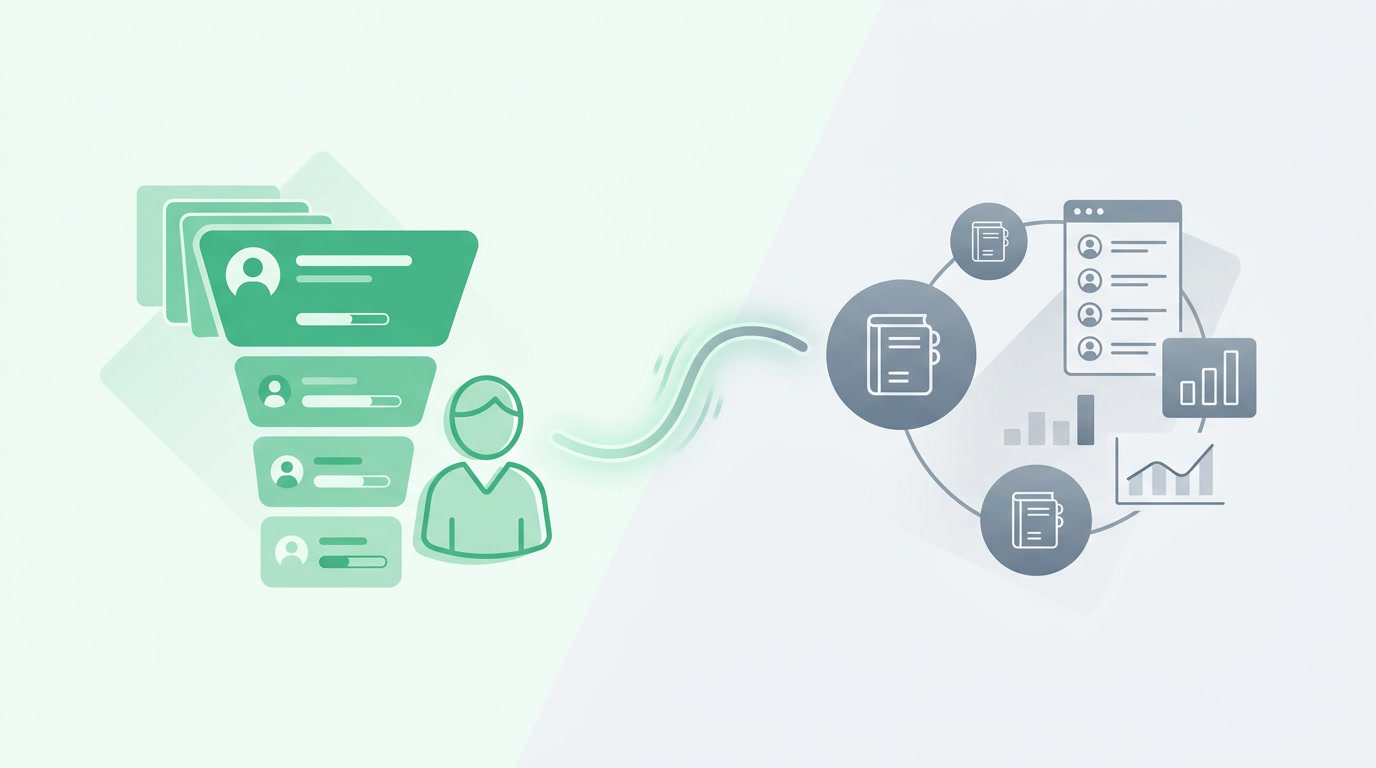
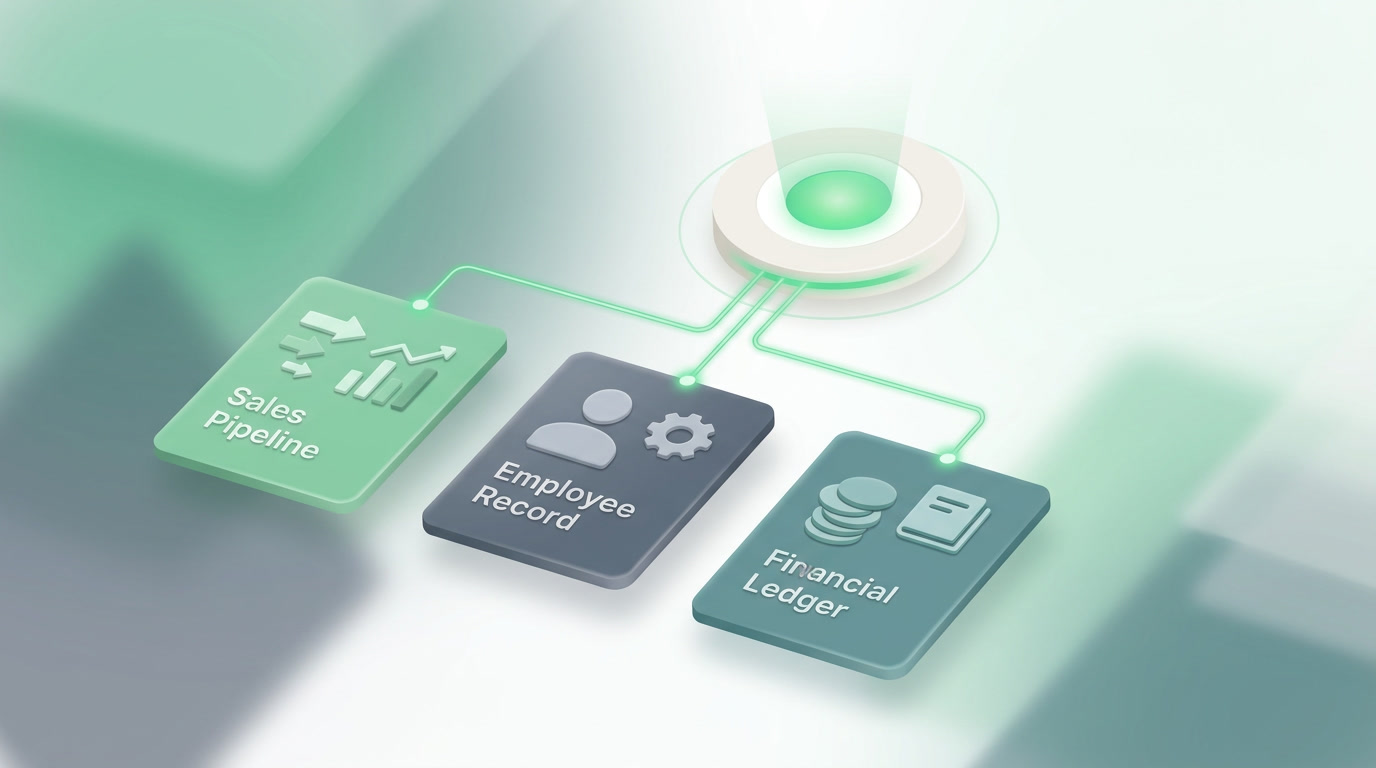
The value isn't in having the modules. It's in the connections between them. When a deal closes, an invoice should already carry the deal behind it. When a customer opens a support ticket, it should already know who they are. When a lead arrives from an ad, it should route to the right salesperson on its own. That linkage, records staying connected across every app, is what separates an ERP from a folder full of disconnected tools.
Why are SAP and NetSuite the wrong ERP for a small business?
SAP and NetSuite are genuinely deep, full supply chain, procurement, warehouse, manufacturing. They're the right choice for a large, complex enterprise. But at small-business scale they're the wrong tool: six-figure budgets, rollouts that run for a year, and an implementation partner you have to hire before the system does a single useful thing.
The cost you see on the license is the smallest part. The real bill is the implementation: mapping your processes, configuring modules, training, the consultants. A small business pays that in the currency it has least of, time and attention, before it ever sees a return. The problem isn't that these systems are bad. It's that you're buying a cargo ship to cross a river.
What should a small-business ERP actually do?
It should cover the whole business, not just one corner, and it should be running before your coffee's cold, not after a quarter of setup. Concretely: sales and customers, people and payroll, and real accounting, on one login, at one per-seat price, with the records connected so nothing gets re-typed between apps.
- All-in-one, genuinely: CRM, HR and payroll, and finance under one roof, plus support desk, bookings, campaigns, forms, and a published website.
- A real ledger. Not "invoices" bolted onto a CRM, but double-entry accounting with a chart of accounts, P&L, and balance sheet under every transaction.
- Setup measured in minutes, not months, with no consultant standing between you and a working system.
- One per-seat price, so cost scales with your team, not with how many separate tools you had to license.
- Web and native mobile, in your language, wherever your team works.
How do the best small-business ERP options compare?
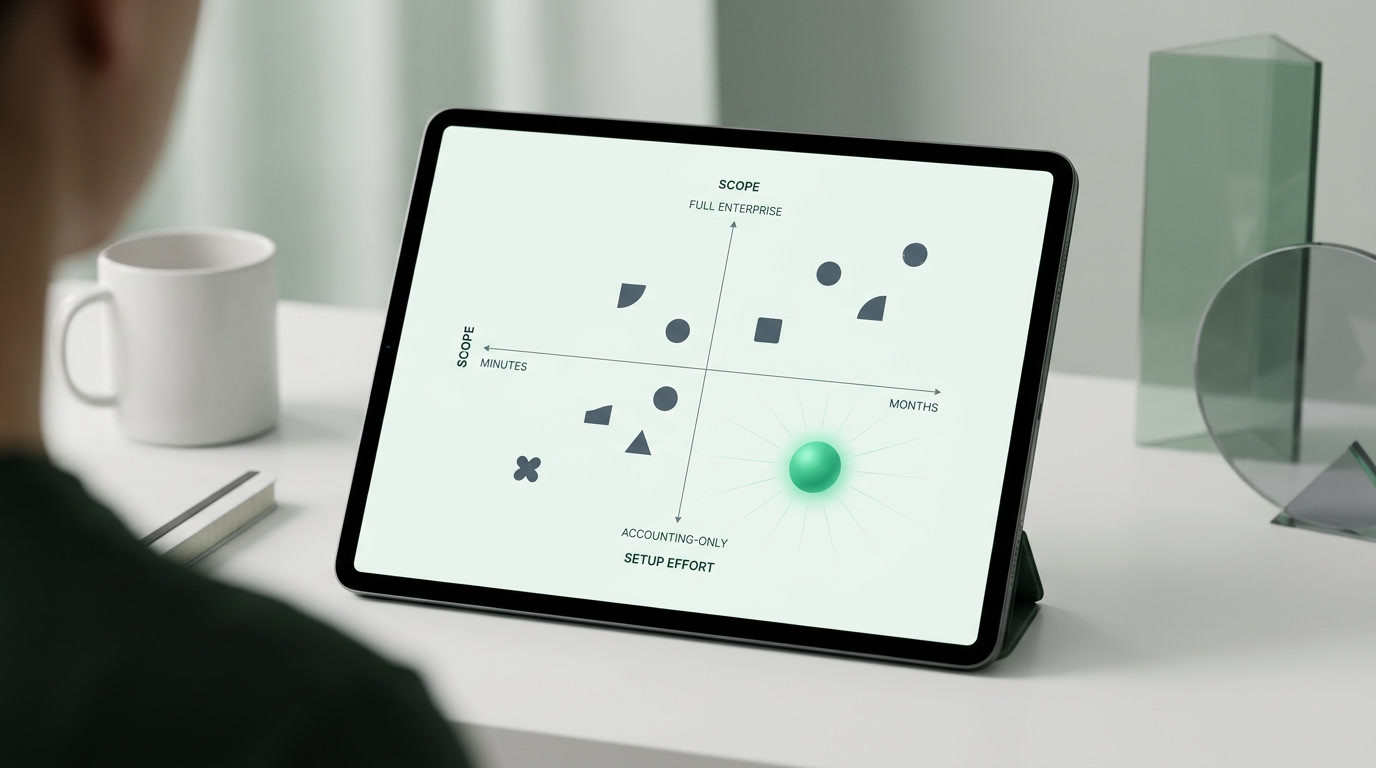
Each of the real options is strong at something. Zoho One is broad and mature. Odoo gives you control if you have the technical hands. NetSuite is the deep enterprise suite. QuickBooks and Xero are excellent dedicated accounting. ERPnBox's edge is a complete, connected business, CRM plus HR/payroll plus a real ledger, built from a conversation with no implementation.
| Option | Best for | Scope | Setup effort | Indicative price |
|---|---|---|---|---|
| ERPnBox | SMBs wanting one connected system, no rollout | CRM + HR/payroll + real double-entry finance + 12 apps | Minutes, AI-built from a conversation | $15–$20/user; 30-day free trial |
| Zoho One | Teams comfortable wiring 40+ apps together | 40+ apps across a broad, mature suite | Moderate; you connect the pieces | ~$37/user |
| Odoo | Technical teams wanting control, often self-hosted | Open-source, modular, very configurable | High; technical setup and upkeep | Free core; paid apps + hosting |
| NetSuite / SAP | Larger enterprises needing full supply chain | Deep ERP incl. procurement, warehouse, manufacturing | Long; six-figure implementation, consultants | Enterprise, custom |
| QuickBooks / Xero | Businesses needing accounting only | Dedicated accounting, no CRM/HR | Low, but separate from your CRM | Accounting-tier subscription |
Where ERPnBox fits, and where it doesn't
ERPnBox is the ERP for small business without the implementation: describe what you do, and the AI builds the workspace, pipelines, invoicing, employee records, payroll, support desk, bookings, then runs it. To be fair, it is not a like-for-like SAP or NetSuite replacement. If you need full supply-chain, warehouse, or procurement depth, those enterprise suites are the right call.
What ERPnBox does give a small business is the whole operating core, connected. The CRM captures leads from ads, web forms, and WhatsApp, routes them by assignment rules, and moves them through a kanban pipeline. The finance side is a genuine double-entry ledger, chart of accounts, invoices, receivables, expenses, cost centers, multi-currency, and reports from P&L to trial balance. HR and payroll sit alongside. And invoices carry their deal, tickets carry their customer, all under one login.
See your business as a working system
Describe what you do in a sentence. Minutes later there's a real ledger under the invoice. Start free for 30 days, no card.
Start freeHow to choose the right one for your business
Start from what you actually run, not from a feature list. If you only need books, a dedicated accounting app is cleaner. If you have technical hands and want deep control, Odoo rewards it. If you're a large enterprise with a real supply chain, NetSuite or SAP earns its cost. If you want your whole business, sales, people, and money, in one connected place without a rollout, that's the small-business ERP category ERPnBox is built for.
Frequently asked questions
What is the best ERP for a small business in 2026?
For most small businesses it's **an all-in-one system covering CRM, HR/payroll, and real accounting on one price**, not an enterprise suite like SAP or NetSuite. ERPnBox fits this by building your whole workspace from a conversation in minutes, with a genuine double-entry ledger. Zoho One and Odoo are also strong depending on your needs.
Is SAP or NetSuite good for a small business?
They're excellent systems but **built for larger enterprises with full supply-chain needs**. At small-business scale the six-figure cost, months-long implementation, and required consultants usually outweigh the benefit. A purpose-built small-business ERP gives you the connected core without that overhead.
How is ERPnBox different from Zoho or QuickBooks?
Zoho One is a broad, mature suite of 40+ apps you wire together yourself. QuickBooks is dedicated accounting, separate from your CRM. **ERPnBox arrives already connected**, CRM, HR/payroll, and a real ledger under one login, built by AI from a description of your business, so records stay linked with no setup work.
Does ERPnBox have real accounting or just invoicing?
**Real accounting.** ERPnBox runs a genuine [double-entry ledger](/finance) with a chart of accounts (26 subtypes), invoices, receivables, expenses, cost centers, multi-currency with FX, VAT and withholding tax, and 14 reports including P&L, balance sheet, trial balance, and cash flow. There's a real ledger under every invoice.
Is ERPnBox a full replacement for SAP or NetSuite?
**No, and we say so plainly.** ERPnBox doesn't cover full supply chain, warehouse, or procurement depth. If your business genuinely needs those, the enterprise suites are the right choice. ERPnBox is built for small and mid-sized businesses that want their whole operating core connected without a long implementation.
How much does a small-business ERP cost?
It varies widely. Enterprise suites run into six figures with implementation; broad suites like Zoho One are around $37/user. **ERPnBox is $15/user (Professional) or $20/user (Growth)**, with a 30-day free trial and no card required, and yearly billing gives two months free. See [pricing](/pricing) for details.