
The short answer
Professional services firms and agencies need one place for pipeline, client and project tracking, retainers, invoicing, bookings, and approvals. ERPnBox connects CRM, Finance, Bookings, Forms, and Approvals in one login and one per-seat price — AI-built in minutes — so records stay linked and time-to-cash shortens.
Professional services and agencies run on a promise: expert work, delivered on time, billed cleanly. Yet the tools that support that promise are usually a patchwork — a CRM for the pipeline, a spreadsheet for projects, an accounting app for invoices, a calendar tool for meetings, and email threads holding it all together. This guide shows why one connected system beats a stack of stitched tools, and where ERPnBox fits for consultancies, creative and marketing agencies, and law and accounting firms.
What business software do professional services firms and agencies actually need?
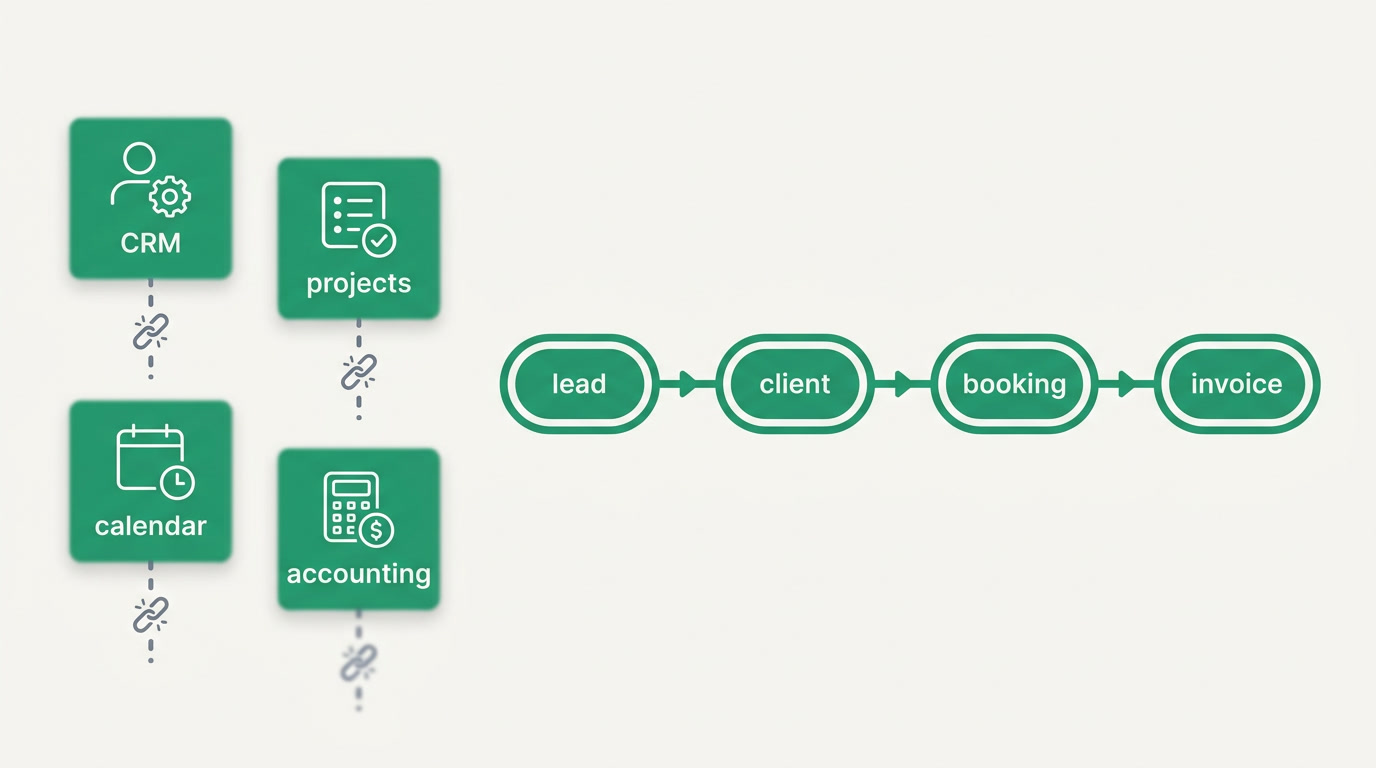
They need one place to run the whole journey from first enquiry to final payment: a sales pipeline, client and project tracking, retainers and invoicing, bookings for meetings, approvals for scope and spend, and a clear read on time-to-cash. When those live in one system, records stay connected and nothing falls between apps.
A consultancy tracks proposals, engagements, and billable hours against a retainer. A creative agency juggles briefs, approvals, and delivery deadlines. A law or accounting firm manages matters, client records, and invoices that must be exact. Different vocabularies, same shape: win the work, deliver the work, get paid for the work — with a paper trail at every step.
Why does one connected system beat a stack of stitched-together tools?

Because the gaps between tools are where money and hours leak. A won deal that never becomes an invoice, an approved scope no one billed for, a retainer quietly overspent — these are seams, not features. One system where the deal, the client, the booking, and the invoice are the same connected record closes those seams and shortens time-to-cash.
Stitched stacks also carry a hidden tax: every tool has its own login, its own bill, and its own export-import ritual to move a client from sales to delivery to finance. ERPnBox replaces that with one login and one per-seat price, where a lead captured from an ad, form, or WhatsApp becomes a client, a booking, and eventually an invoice without leaving the system.
| The job to be done | Stitched tools | One connected system |
|---|---|---|
| New enquiry to signed client | CRM, then re-key into project and billing apps | Same record moves from lead to client to invoice |
| Retainers and invoicing | Separate accounting app, manual reconciliation | Double-entry finance beside the client record |
| Booking meetings | A calendar tool disconnected from the pipeline | Bookings tied to the client and the deal |
| Scope and spend approvals | Email threads and lost sign-offs | Approval processes with an audit trail |
How does ERPnBox handle the pipeline, projects, and time-to-cash together?
By putting sales, delivery, and finance in one workspace. The CRM captures leads from ads, forms, and WhatsApp, moves them through your pipeline with workflow automation and assignment rules, and hands the won client straight to Finance — where estimates, invoices, credit notes, payments, and expenses live in a real double-entry ledger with multi-currency support. No re-keying between the sale and the invoice.
Around that spine sit the apps a services firm leans on daily: Bookings for scheduling client meetings, Forms to turn a public /f/ page into a lead, Approvals to sign off scope and spend, Payment Plans for installment retainers, Documents for DOCX proposals and contracts, and Email as a full inbox that files messages onto the right record. Workflow rules, SLAs, and blueprints keep the whole thing moving without babysitting.
Analytics close the loop: seven chart types with drill-down, KPIs with targets, leaderboards, and a report builder that emails itself on a schedule. You can see win rates, outstanding invoices, and where deals stall — and act on it from the same screen. It works on the web and on native iOS and Android, in your language.
How does ERPnBox compare to the usual alternatives?
Each alternative is genuinely good at something. Salesforce and HubSpot are excellent at CRM and marketing. QuickBooks and Xero are strong accounting tools. Zoho One is a broad suite. ERPnBox is different in one way that matters for a small services firm: it is all of that in one login and one per-seat price, built by a conversational AI in minutes rather than a long implementation.
| Option | Real strength | The trade-off for a small firm |
|---|---|---|
| Salesforce | Best-in-class CRM depth | Expensive and complex; finance lives elsewhere |
| HubSpot | Strong marketing and CRM, free tier | Gets pricey to scale; still needs accounting |
| QuickBooks / Xero | Excellent accounting | Separate from your CRM and pipeline |
| Zoho One | 40+ apps for a low price | Apps you wire together yourself |
| NetSuite / SAP | Deep enterprise ERP and supply chain | Six-figure cost, long implementation |
ERPnBox is the ERP for small business — AI-built, all-in-one, without the implementation. Your Business, Unboxed.
See your whole firm in one workspace
Start a 30-day free trial. No card required. Professional plans from $15 per seat.
Start free trialHow do you set it up without a long implementation?
You describe your firm in plain language and a conversational AI builds the workspace in minutes — modules, fields, pipeline stages, and dashboards shaped to how you actually work. Then you refine it: 23 field types including formula, rollup, and sub-tables, layout rules, dependent picklists, and document templates let an ops lead adjust things without a developer.
Because it is one system, there is no data migration between a CRM and a billing tool to plan for, and no integration project to keep alive. Start with the CRM and Bookings, add Finance when you are ready to invoice from the same records, and turn on approvals and automation as your processes settle. The system grows with the firm, not ahead of it.
Frequently asked questions
Is ERPnBox a good CRM for agencies specifically?
Yes. The [CRM](/crm) captures leads from ads, forms, and WhatsApp, moves them through a pipeline with seven view types, and **connects each client to bookings, approvals, and invoices in the same system** — so a creative or marketing agency runs sales and delivery without stitching separate tools together.
Can it handle retainers and invoicing for professional services?
Yes. [Finance](/finance) is a real double-entry ledger with estimates, invoices, credit notes, payments, and expenses, plus multi-currency support. Payment Plans handle installment retainers, and because invoices sit beside the client record, you can **track time-to-cash without a separate accounting app**.
How is this different from buying a CRM and an accounting tool separately?
Separate tools mean two logins, two bills, and constant export-import to move a client from sales to finance. In ERPnBox the **deal, client, booking, and invoice are one connected record**, so nothing is re-keyed and nothing falls between apps.
Do law and accounting firms need custom modules to fit their work?
They can build them easily. **Custom modules and 23 field types**, dependent picklists, layout rules, and document templates let you model matters, clients, and engagements in your own terms — configured by an ops lead, no developer required.
What does it cost, and can we try it first?
There is a **30-day free trial with no card required**. Paid plans are $15 per seat for Professional, $20 for Growth, and custom pricing for Enterprise, with [two months free on yearly billing](/pricing) — one per-seat price for the whole connected system.