The short answer
Real estate runs on speed and long cash cycles, so brokerages and developers need one platform that follows a lead from first call through payment plans and commissions. ERPnBox pairs a mobile lead pipeline with real double-entry finance and document management, at one per-seat price, so listings, leads, and money stay on one connected record.
In real estate, two gaps quietly cost you money. The first is between a lead arriving and someone calling it back. The second is between a deal closing and a commission actually landing in the right pocket, sometimes months later. Most property businesses run each gap on a different tool.
The industry has already voted with its wallet: real estate CRM adoption rose from 47% in 2021 to 61% in 2025, and 78% of firms run on cloud tools. But adoption is only half the story. The half nobody mentions is that leads, listings, and finance usually live in three places that don't speak to each other, so somebody re-types the same deal three times and one of those times is wrong.
Why does real estate need CRM and finance in one place?
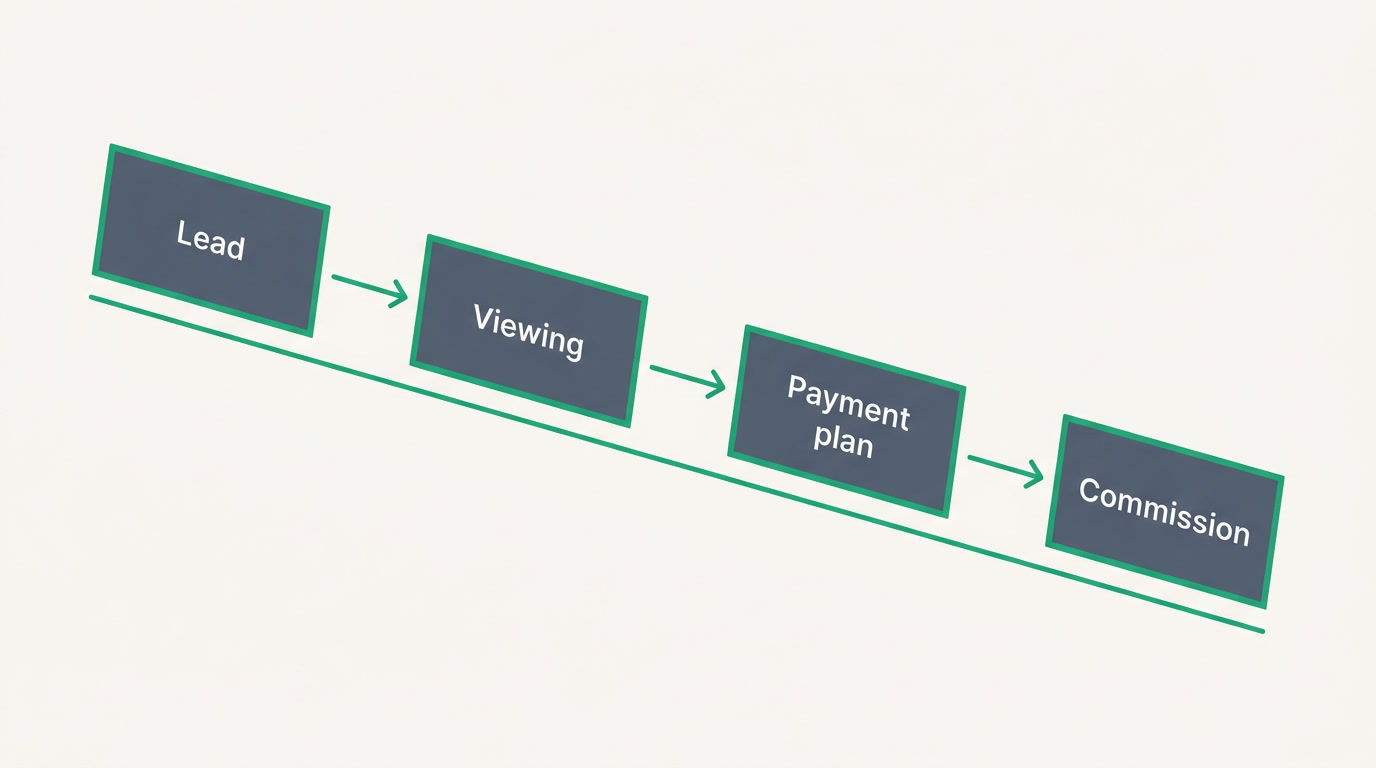
Because a property deal is a single story that runs for months, and finance is its ending. A lead becomes a viewing, a viewing becomes a reservation, a reservation becomes a payment plan, and each installment becomes a commission split. When those live in separate tools, the story breaks between chapters and the numbers stop matching.
A generic sales tool can hold the lead. A separate accounting tool can hold the invoice. What neither can do is keep them on the same connected record, so that when a buyer pays their third installment, the person who sold the unit sees it without asking finance. In ERPnBox, the invoice carries its deal and the payment posts to a real ledger, so the sales side and the money side are looking at one truth.
How do you stop losing leads to slow follow-up?

You route every inquiry to a named agent the moment it lands, on the device they actually carry. Slow first response is the single biggest reason property leads go cold, and it is almost always a routing problem, not an effort problem. Nobody called back because nobody was clearly assigned.
ERPnBox assigns leads by round-robin, team, or territory the instant they enter the pipeline, then pushes them to the agent's phone through the native mobile app. The agent updates the deal from a car outside a building, not from a desk that evening. That matters because in real estate the honest truth is simple: the tool only works if the agents actually open it. Adoption is the number-one reason these projects succeed or fail, so agent-first isn't a nice-to-have, it's the whole point.
How do you track commissions and payment plans over long cycles?
You put the payment schedule on the deal itself and let each installment post to the ledger as it's paid. Property sales rarely settle in one payment. A developer sells on a plan spread across two years; a brokerage waits on staged commissions. Spreadsheets track this until the day two people edit the same one.
ERPnBox handles installment payment plans as first-class records: due dates, amounts, what's paid, what's outstanding, all attached to the buyer and the unit. Because the Finance app is real double-entry — not a running total in a sheet — a received installment is an actual posting, and the commission owed against it is visible the same day. You reconcile against your bank, in multiple currencies, without exporting anything to a separate accounting package.
On bank feeds, honestly
Finance now supports live bank feeds through Stripe Financial Connections — you connect your bank inside Stripe's own secure window and transactions flow into the same matching pipeline as an imported statement. The honest limit: this connects US bank accounts today (around 5,000 institutions), and while businesses in 34 countries can use Stripe, non-US accounts aren't supported yet. So: connect your bank where Stripe supports it, or import a statement anywhere.
What does the pain-to-capability map actually look like?
Every real estate operator recognizes the same short list of pains. Here is each one against the capability that answers it, so you can judge fit without a demo script.
| The pain | What handles it in ERPnBox |
|---|---|
| Leads go cold before anyone calls | Instant auto-assignment by round-robin, team, or territory, pushed to the agent's phone |
| Agents won't use clunky desk tools | Native mobile app; update a deal from the field in seconds |
| Commissions and installments tracked in spreadsheets | Payment plans and double-entry Finance attached to the deal and unit |
| Listings, leads, and money in three systems | One connected record across CRM, Finance, and 12 apps |
| Contracts and documents scattered | Document management on the record, generated and stored per deal |
| No clear view of pipeline or agent performance | Analytics dashboards over live pipeline and revenue data |
Is this the same as SAP or NetSuite for property?
No, and it's worth being straight about it. SAP rivals and NetSuite are deep enterprise systems with full supply-chain, procurement, and warehouse depth. If you need that, buy that. ERPnBox is the all-in-one business system for the operator who wants the leads, the money, and the people in one place — without a year-long implementation and a six-figure invoice.
The same fairness applies to accounting. Zoho Books and QuickBooks Online are excellent, dedicated accounting tools with broader bank-feed coverage than we have today. If accounting is the only thing you need, they're a strong choice. ERPnBox's difference isn't better accounting — it's that the ledger lives inside the same platform as your CRM, HR, and 12 apps, at one per-seat price, so finance isn't a separate tool you reconcile against your sales system.
How fast can a brokerage actually start?
Minutes, because you describe your business in plain language and the AI builds the workspace. You tell it you sell units on payment plans with agents split across territories, and it shapes the modules, fields, and pipeline stages to match — then you refine. No consultant, no blank database to design from scratch.
The important distinction: the AI builds your workspace on top of an already-hardened platform. It's not generating a fresh app you'd have to babysit for security and bugs. You get the speed of describing what you want, without owning the maintenance of what gets built. See how the builder works, or compare tiers on pricing.
Put leads, deals, and money on one record
Describe your property business and watch the workspace build itself. 30-day free trial, no card.
Start freeFrequently asked questions
Is ERPnBox a full property-management suite with listings syndication?
ERPnBox handles the business side of a property operation: leads, pipeline, viewings, payment plans, commissions, documents, finance, and the people who run it. You can model listings as records connected to deals. It is not a portal-syndication tool that pushes listings to third-party property marketplaces, so if that specific feed is central to you, pair us with your listings channel.
Can agents work entirely from their phones?
Yes. There's a native mobile app for updating deals, logging viewings, and checking assignments from the field. Agent adoption is the single biggest predictor of whether a real estate CRM succeeds, so the mobile experience is designed for the car and the site, not just the desk. Note that mobile does not currently include a kanban board or offline mode.
How does commission tracking work across a two-year payment plan?
The payment plan lives on the deal with each installment's due date and amount. As installments are received they post to a real double-entry ledger, so the commission earned against each stage is visible as it's paid rather than reconstructed at year-end from a spreadsheet. Multi-currency is supported, which matters when buyers or investors pay in different currencies.
What does it cost for a real estate team?
One per-seat price covers CRM, Finance, HR, and all 12 apps — there's no separate accounting subscription. As of mid-2026: Professional is $15/user (3,000 AI Credits), Growth is $20/user (6,000 credits, most popular), and Enterprise is custom with BYOK and SSO. Paying yearly gives you two months free, and there's a 30-day trial with no card.
We only need accounting. Should we still switch?
Probably not, and we'd rather say so. If accounting is the entire job, dedicated tools like Zoho Books and QuickBooks Online have deeper accounting features and broader bank-feed coverage than we do today. ERPnBox earns its place when you want the ledger connected to your leads, deals, and people in one platform, rather than reconciling a standalone accounting tool against a standalone sales tool.