The short answer
Recruitment agencies lose placements when the ATS, CRM, and billing sit in separate tools that never talk. ERPnBox puts the candidate pipeline, client CRM, CV documents, and timesheet-to-invoice billing on one platform, built by conversational AI in minutes, at one per-seat price with a 30-day free trial.
A staffing agency runs two businesses at once. One finds candidates. One wins clients. When those two live in separate systems that never speak, the seams are where money leaks — a placement that stalls because nobody linked the candidate to the open role, an invoice that goes out late because the timesheet lived in a spreadsheet.
This guide is for the agency owner or operations lead who is tired of re-typing the same person into three tools. It covers what a connected recruitment system actually needs, where a purpose-built applicant tracking system still wins, and how to stand up your own candidate and client pipeline without a six-month rollout.
Why do recruitment agencies outgrow their first set of tools?
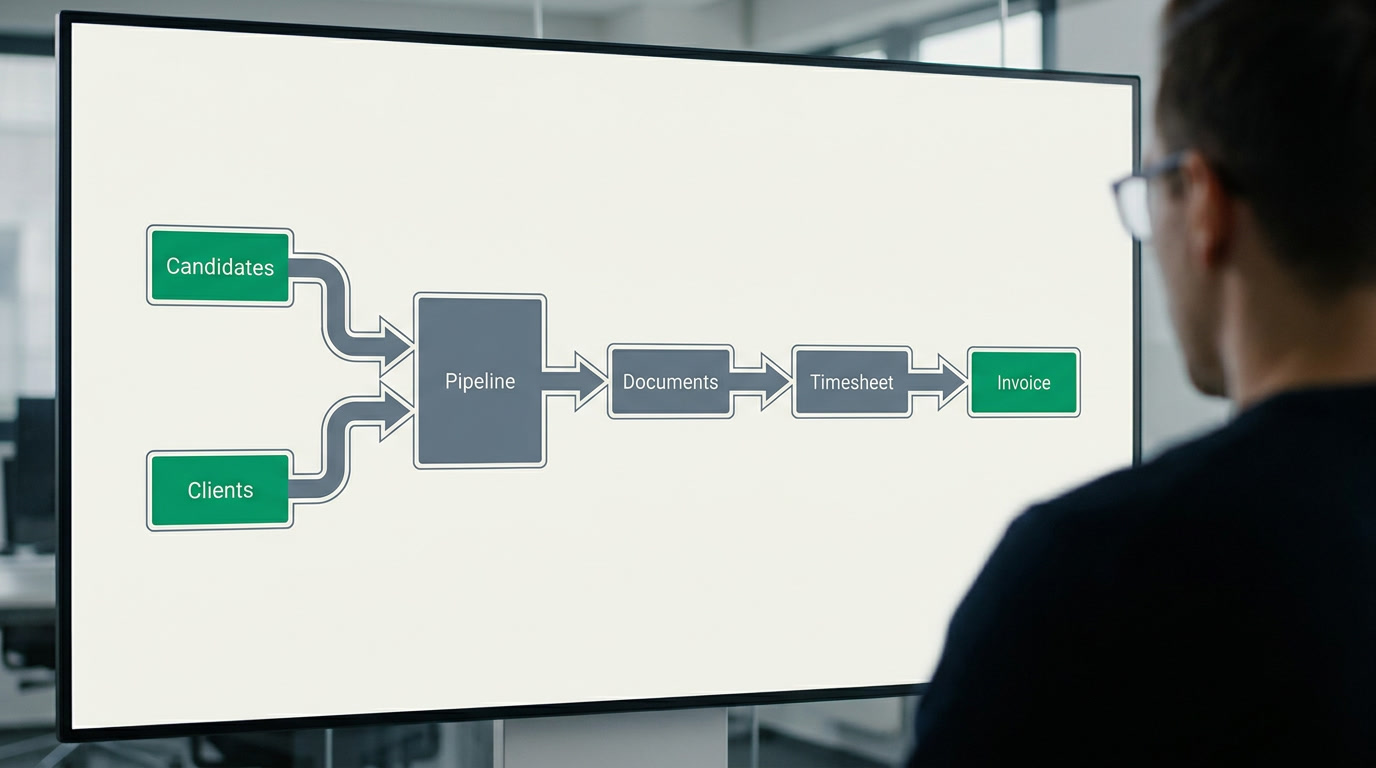
Because the work is a chain — sourcing to placement to timesheet to invoice — but the tools are islands. An ATS holds candidates, a separate CRM holds clients, timesheets live in spreadsheets, and accounting sits in a fourth app. Every handoff means manual re-entry, and every re-entry is a chance to lose a placement or bill late.
The industry has largely moved to answer this with data. Roughly 78% of high-growth staffing firms now run AI inside their recruitment CRM, and the value they cite is the same one every time: a single view where the candidate, the client, and the back office stop being three disconnected records. The buying trigger is rarely a missing feature — it is the manual re-entry between tools that were never meant to work together.
What should a unified recruitment platform actually do?

It should carry one record from first contact to paid invoice without a copy-paste in the middle. In practice that means a candidate pipeline, a client pipeline, assignment rules that route work, CV and contract documents attached to the person, timesheet-driven invoicing, and a mobile app your recruiters will actually open between meetings.
- Candidate pipeline — every applicant as a record with status, skills, and the roles they are being considered for.
- Client pipeline — companies and open roles as connected deals, so a placement links back to the account that pays for it.
- Assignment rules — new candidates or inbound roles routed to the right recruiter automatically, not left in a shared inbox.
- Documents — CVs, right-to-work checks, and signed contracts attached to the candidate they belong to.
- Timesheet-to-invoice — hours logged for temp and contract placements flow into an invoice instead of a spreadsheet.
- Mobile — a native app so recruiters can update a candidate or check a client on the move.
Where does a dedicated ATS like Bullhorn still win?
On depth. A purpose-built platform like Bullhorn has spent decades on recruitment-specific machinery — parsing, candidate matching, job-board integrations, pay-and-bill at scale — and it is genuinely deep. If recruitment is the only thing your firm does and you need that specialized depth, a dedicated ATS is a serious, well-earned choice.
The trade-offs are cost and scope. Bullhorn is priced around $99 per user per month, and it is a recruitment system — your HR, payroll, and the broader finance beyond pay-and-bill still live in other tools you wire together. ERPnBox is not trying to out-recruit a specialist ATS on parsing depth. Its argument is different: one platform for the whole agency, built by AI, at one per-seat price.
| What you need | Dedicated ATS (e.g. Bullhorn) | ERPnBox |
|---|---|---|
| Recruitment depth (parsing, matching, job boards) | Deep, purpose-built | Solid pipeline + documents; not specialist parsing |
| Client CRM | Included | Included, same platform |
| HR & payroll | Separate tool | Built in |
| Real double-entry finance | Beyond pay-and-bill, separate | Built in, double-entry ledger |
| Set-up | Guided implementation | AI builds it in minutes |
| Price | ~$99/user/mo | From $15/user/mo, all apps |
The honest line
If you need the deepest possible recruitment machinery and nothing else, buy the specialist. If you want the candidate pipeline, the client CRM, HR, and the money on one platform your team actually logs into, that is the case for ERPnBox.
How do you build a candidate module without code?
You describe it. In ERPnBox you tell the conversational builder what a candidate record should hold — name, role, skills, status, source, expected rate — and it creates the module, the fields, and the pipeline stages in minutes. There is no schema to draw and no consultant to book. Then you refine it in plain language until it matches how your desk actually works.
Here is the key difference from building your own app on a code-generation tool. Tools like Replit, Lovable or Bolt are excellent for prototypes and internal tools. But industry research is blunt about the last mile: Veracode's 2025 analysis found roughly 45% of AI-generated code introduces a known security flaw, and the hard 30% — permissions, error handling, the ledger math — is exactly what a staffing back office cannot get wrong.
ERPnBox flips that. The AI builds your workspace — modules, fields, workflows — on top of a system where the auth, the record-level permissions, and the double-entry ledger are already engineered and maintained. You get the speed of AI without owning the maintenance and security bill of a generated codebase.
How does a placement turn into a paid invoice?
Because the record never leaves the platform, the money follows the work. A placement is linked to its client account; hours logged against a temp or contract placement flow into an invoice; that invoice carries its deal and posts to a real ledger — no re-keying, no reconciling your sales system against a separate accounting app.
Dedicated accounting tools like Zoho Books and QuickBooks Online are genuinely excellent and, today, have broader automatic bank-feed coverage than we do — if you only need accounting, they are a fair recommendation. ERPnBox's difference is not better accounting; it is that the ledger lives inside the same platform as your candidates and clients. On bank feeds, be practical: connect your bank where Stripe Financial Connections supports it (US bank accounts today), or import a statement anywhere.
Build your recruitment workspace in an afternoon
Describe your desk, watch the candidate and client pipelines appear, and run the whole agency on one per-seat price. 30-day free trial, no card.
Start freeWhat does it cost to run the whole agency here?
One per-seat price covers the candidate pipeline, client CRM, HR and payroll, finance, and the rest of the apps — not a stack of separate subscriptions. As of mid-2026, Professional is $15 per user (3,000 AI Credits), Growth is $20 per user (6,000 credits, most popular), and Enterprise is custom for firms that need their own AI keys or single sign-on. Pay yearly and two months are free.
The tool your recruiters won't open is worth nothing, no matter how deep it is. Adoption — people actually logging in — is the number-one thing that decides whether a system pays off.
Frequently asked questions
Is ERPnBox a replacement for a specialist ATS like Bullhorn?
Not on pure recruitment depth. A dedicated ATS has decades of specialized machinery — CV parsing, candidate matching, job-board integrations — and if that depth is your only need, it is the right buy. ERPnBox's edge is breadth: candidate pipeline, client CRM, HR, payroll, and real finance on **one platform** at one per-seat price, built by AI rather than a long implementation.
Can I track both candidates and clients in the same system?
Yes — that is the point. You get a candidate pipeline and a client pipeline on the same platform, and the records stay connected: a placement links to the client account that pays for it, and the invoice carries the deal. No exporting candidates from one tool to reconcile against clients in another.
How does timesheet-to-invoice work for temp and contract placements?
Hours logged against a placement flow into an invoice tied to the client account, and that invoice posts to a real double-entry ledger inside the same platform. Because the finance sits with the CRM, you are not re-keying hours from a spreadsheet into a separate accounting app.
Where do CVs and contracts live?
Attached to the candidate they belong to. CVs, right-to-work checks, and signed contracts are stored on the record itself, so anyone with access to that candidate sees the documents in context rather than hunting through a shared drive.
Can recruiters use it on their phones?
Yes. There is a native mobile app alongside the web app, so a recruiter can update a candidate's status or check a client between meetings. It works in any language, with the same connected records as the desktop.
How long does it take to set up?
Minutes, not months. You describe your candidate module, client pipeline, and assignment rules to the conversational builder and it creates them, then you refine in plain language. There is no schema to draw and no implementation project to fund — start on the 30-day free trial with no card.