The short answer
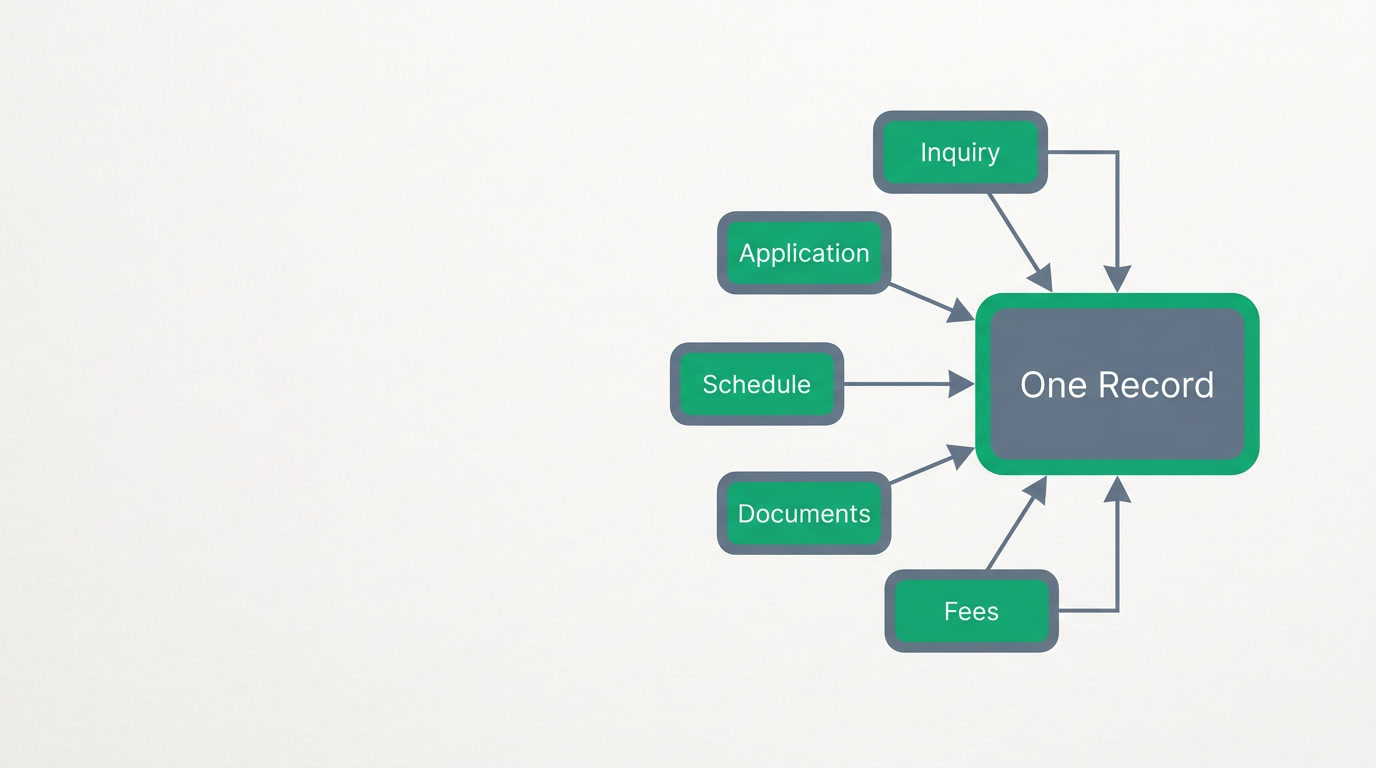
Education and training providers lose revenue when inquiries, applications, and fees live in separate tools. ERPnBox puts the enrollment pipeline, nurture email and WhatsApp, fee invoicing with installment plans, scheduling, documents, and funnel analytics on one login at one per-seat price — so a prospective student never falls through a gap between systems.
Most education and training businesses do not have a marketing problem. They have a handoff problem. The inquiry arrives on one tool, the application sits in another, the fee lives in a spreadsheet, and the course calendar is on someone's laptop. Between each of those tools is a gap, and prospective students fall into the gaps.
This is a practical look at what software for a school, academy, or training provider should do — from the first inquiry to the last installment — and where one connected platform beats a stack of disconnected apps. We will be honest about what we are and are not: ERPnBox is front-office, admissions, and fees, not a full student information system.
Why do inquiries leak before they ever enroll?

Inquiries leak because nobody owns them. A prospective learner emails, fills a form, or messages on WhatsApp, and unless that inquiry lands in a pipeline with an owner and a next step, it waits. A learner who waits enrolls somewhere else. The fix is an enrollment pipeline where every inquiry has a stage, an owner, and a follow-up that fires on time.
With a CRM built for this, a web form or a landing page drops the inquiry straight onto a board — Inquiry, Contacted, Application Started, Application Complete, Offer, Enrolled. Assignment rules hand it to a counselor. If the counselor does not act, the record nags. Nothing sits in an inbox waiting to be noticed.
How do you stop applications from stalling half-finished?
Half-finished applications are a nurture problem, not a form problem. A learner starts, gets distracted, and never returns — unless something reminds them. Automated nurture over email and WhatsApp brings them back: a reminder about a missing document, a note that a cohort is filling, a link to complete the last step.
Because the message is tied to the applicant's stage, the sequence stops the moment they finish. No learner gets a "complete your application" nudge after they have already paid. The comms and the pipeline are the same system, so they always agree.
An honest scope note
ERPnBox handles admissions, comms, and fees — the front office. It is not a full student information system or a grading gradebook. If you also deliver training, our separate Learning app manages courses and material; but for records, transcripts, and academic compliance, keep your dedicated SIS. We are the business side of the school, not the classroom.
Can one tool handle tuition, fees, and installment plans?
Yes — and this is where a connected platform earns its keep. When a learner enrolls, the Finance side raises a tuition invoice against that same record, splits it into an installment plan, and tracks each payment on a real double-entry ledger. Admissions and money are not two systems you reconcile; they are one record you read.
Payments post to the ledger as they arrive. You can connect your bank to pull transactions in automatically — live bank feeds run through Stripe Financial Connections, and you connect it inside Stripe's own secure window, so we never see your banking credentials. One honest limit: that connection reads US bank accounts today. Everywhere else, importing a statement remains the path — the same import, matching, and reconciliation either way.
What does a connected education workspace actually look like?
It looks like one login where an admissions counselor sees the inquiry, the application, the cohort schedule, the signed enrollment agreement, and the fee balance on a single page. Below is how the disconnected version compares to the connected one — same work, very different day.
| The job | Disconnected stack | One connected platform |
|---|---|---|
| Capture an inquiry | Form tool emails a lead; someone copies it into a sheet | Form drops onto the pipeline with an owner and next step |
| Chase a stalled application | Manual reminder — if anyone remembers | Nurture email and WhatsApp fire by stage, stop on completion |
| Bill tuition in installments | Accounting app, re-keyed from the CRM | Invoice and payment plan raised on the same enrollment record |
| See why enrollment is down | Export three tools into a spreadsheet | Funnel report reads the live pipeline |
| Work from a campus visit | Desktop tool, no real mobile | Native mobile app, same records |
How do you actually see where enrollment breaks down?
You see it in a funnel report that reads the live pipeline instead of a stale export. It shows how many inquiries became applications, how many applications completed, and how many offers turned into paid enrollments — by course, by source, by counselor. The number that drops tells you where to spend your next week.
Because the report sits on the same records as the pipeline, there is nothing to reconcile and nothing to export. Be clear on what this is not: it is honest reporting on what happened, not a forecast or a prediction of who will enroll next term. We do not sell a crystal ball.
Where do dedicated accounting tools still win?
If all you need is bookkeeping, dedicated tools are excellent and often the right call. Zoho Books and QuickBooks Online are mature, deep accounting products with broader automatic bank-feed coverage than we have today — QuickBooks reaches 33-plus countries, and both plug into a large accountant ecosystem. Our difference is not "better accounting."
Our difference is that the ledger lives inside the same platform as your admissions, comms, scheduling, and HR — one per-seat price, no second accounting subscription to reconcile against your enrollment system. If you only need books, use the dedicated tool. If you are tired of your fees living apart from your students, that is the case for one platform.
See it built for your programs
Describe your courses in plain words and watch the workspace take shape — pipeline, fees, and comms, in minutes. 30-day trial, no card.
Build your workspaceAn enrollment team does not need more tools. It needs the tools it has to stop losing learners in the space between them. One login, one price, one connected record from inquiry to paid tuition — that is the whole argument, and for a growing academy it is usually enough.
Frequently asked questions
Is ERPnBox a student information system or a learning management system?
No — and we would rather say so than oversell. ERPnBox runs the **front office**: admissions pipeline, nurture comms, fee invoicing, installment plans, scheduling, documents, and funnel reporting. It is not a gradebook, transcript system, or academic-compliance SIS. If you deliver training, our separate [Learning app](/apps) manages courses and material, but for official student records keep your dedicated SIS alongside us.
Can I bill tuition in installments and track each payment?
Yes. When a learner enrolls, the [Finance side](/finance) raises a tuition invoice on that record and splits it into a payment plan. Each installment posts to a real double-entry ledger as it is paid, so a counselor sees the outstanding balance on the same page as the application. Invoices carry their enrollment, so finance and admissions never disagree.
Does it connect to my bank?
Where Stripe supports it, yes. [Live bank feeds](/finance) run through Stripe Financial Connections — you connect inside Stripe's secure window, and we never see your credentials. Today that connection reads US bank accounts. Everywhere else, importing a statement is the path, and it flows through the same matching and reconciliation. Connect your bank where Stripe supports it, or import a statement anywhere.
Can counselors work from a phone during a campus visit?
Yes. A [native mobile app](/mobile) shows the same inquiries, applications, and fee balances as the web. A counselor at an open day can log an inquiry, check a cohort, and move a learner along the pipeline without waiting to get back to a desk. It is a real app, not a shrunken website.
How much does it cost for a small academy?
One per-seat price covers CRM, Finance, HR, and the other apps — no separate accounting bill. As of mid-2026, Professional is $15 per user with 3,000 AI Credits, and Growth is $20 per user with 6,000 (most popular). A [30-day trial](/pricing) needs no card, and paying yearly gives you two months free. Enterprise adds bring-your-own-key AI and single sign-on.