
The short answer
Professional services firms sell time, not stock, so their numbers are billable hours, utilization and project profitability. ERPnBox connects pipeline, quoting, project invoicing, documents and HR in one platform at one per-seat price, so a deal flows to a billed invoice without re-typing it into three separate tools.
If your firm sells hours and expertise, your product doesn't sit in a warehouse — it sits in your team's calendar. That single fact breaks most business software, because most of it was built to count things on shelves. You count something harder: billable hours, utilization, and whether a project made money after the people who delivered it were paid.
So the marketing agency, the consultancy, the advisory practice and the creative studio all end up with the same patchwork: one tool for the sales pipeline, another for projects, a spreadsheet for time, and an accounting package no one in delivery ever opens. The seams between them are where hours go unbilled and margin quietly disappears.
Why do agencies and consultancies outgrow generic business tools?
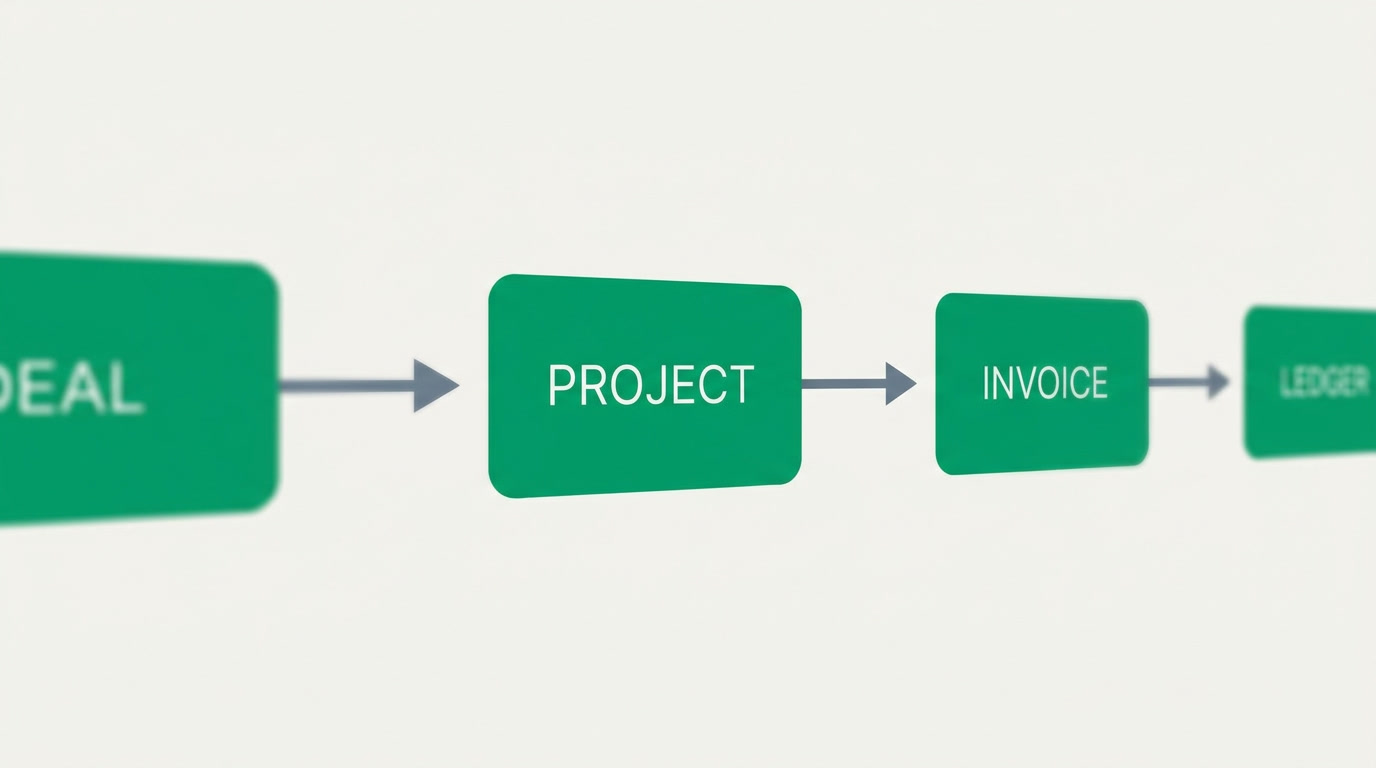
Because generic tools are built around inventory and orders, not people and time. A firm that sells expertise lives or dies on three numbers a stock-oriented system never asks about: utilization (how much of paid time is billable), project profitability (revenue minus the true cost of delivery), and realization (how much of what you quoted you actually collect). When those live in different tools, no one owns the whole number.
The disconnect is not just annoying — it leaks revenue. A scope agreed in the CRM is re-typed into a project tool, then re-typed again into an invoice. Each re-entry is a chance to forget a change order, drop an hour, or bill last month's rate. The winning setup for these firms is boringly consistent: one place where the deal, the project, the people and the invoice are the same connected record.
How does a deal become a billed invoice without re-typing it?

It stays one record the whole way. In ERPnBox the opportunity you win in the pipeline carries its scope, contact and value into a project, and when you invoice, the invoice already knows the deal it belongs to. Payments post to a real double-entry ledger. Nothing is copied between systems, so nothing falls through the gap between them.
- Pipeline & quoting — track opportunities, send quotes, and turn a won deal into a project without re-keying the scope.
- Project invoicing — bill by milestone, retainer, or a fixed fee, with each invoice linked to the deal and client it came from.
- Finance — a real double-entry ledger, expenses, multi-currency and reconciliation, so delivery and money share one source of truth.
- HR & people — the same team you staff on projects is the team you pay, so headcount cost isn't a separate spreadsheet.
- Documents — proposals, statements of work and contracts live on the record they belong to, not in a shared drive no one can find.
Where we're honest with you
ERPnBox tracks projects and time-to-invoice at a business level — enough to see a project's revenue against its cost and to bill accurately. It is not a specialized professional-services-automation suite with deep resource-planning, capacity forecasting and staffing optimization. If sophisticated resource scheduling is the core of your operation, tell us and we'll be straight about the fit.
One connected suite or best-of-breed tools you wire together?
Both are legitimate. Best-of-breed gives you the deepest tool in each category; a connected suite gives you one record and one bill. The honest deciding question is whether your losses come from shallow features or from the gaps between tools. For most agencies and consultancies, the gaps cost more.
| What matters to a services firm | Stitched-together tools | ERPnBox connected suite |
|---|---|---|
| Deal → project → invoice | Re-typed at each handoff | One connected record end to end |
| People cost vs project revenue | Lives in HR + a spreadsheet | HR, payroll and Finance in one place |
| Billing model | Often invoicing-tool dependent | Milestone, retainer or fixed fee |
| Adoption by the team | Several logins, several habits | One login, web and native mobile |
| Price | A subscription per tool | One per-seat price for all apps |
| Deepest single-category features | Best-of-breed wins here | Broad and connected, not the deepest |
If your only need is accounting, a dedicated tool like Zoho Books or QuickBooks Online is excellent and has broader automatic bank-feed coverage than we do today — we'll happily say so. Our Finance connects your bank where Stripe Financial Connections supports it (US bank accounts), and everywhere else you import a statement, which runs through the same matching and reconciliation. The difference isn't better accounting — it's that the ledger lives inside the same platform as your CRM, projects and people, so finance isn't a separate tool you reconcile against your sales.
Why does adoption decide whether any of this works?
Because software your team won't open is worth nothing, however deep it is. Across every services vertical, the single biggest reason a rollout fails is that people quietly go back to email and spreadsheets. A tool consultants and account leads actually use every day beats a more sophisticated one they avoid — so simplicity and a fast, native mobile experience are features, not niceties.
This is where the AI build matters. You describe your firm in plain language — your service lines, your billing model, your stages — and ERPnBox shapes the workspace to match in minutes, then keeps running it. You get that speed on top of a maintained, hardened platform, not a fragile app you'd have to babysit. If you've watched a prototype tool break the moment real work hit it, that difference is the whole point.
See your firm's workspace built in minutes
Describe how you sell, staff and bill. Start a 30-day free trial — no card required.
Start freeWhat does this look like day to day?
A prospect comes in, you track the opportunity, send a quote, and win it. The scope becomes a project without re-typing. Your team logs time against it; you invoice by milestone or retainer; the payment posts to the ledger; and the profitability view shows revenue against the cost of the people who did the work. One login, one bill, records that stay connected across every app — in any language your team works in.
You don't sell chairs. You sell the hours your people spend well. Your software should count exactly that.
Frequently asked questions
Is ERPnBox a full professional-services-automation (PSA) platform?
Not in the deep-resource-planning sense. ERPnBox tracks **projects and time-to-invoice at a business level** — enough to bill accurately and see a project's revenue against its cost. It does not do sophisticated capacity forecasting or staffing optimization. If that scheduling depth is your core operation, a specialized PSA tool may fit better, and we'll say so.
Can we bill by retainer, milestone and fixed fee?
Yes. You can invoice by milestone, on a recurring retainer, or as a fixed fee, and each invoice stays linked to the deal and client it came from. Payments post to a real double-entry ledger, so your billing and your accounts are the same source of truth rather than two systems to reconcile.
How is this different from just using a great accounting tool?
Dedicated tools like [Zoho Books](https://www.zoho.com/books) and [QuickBooks Online](https://quickbooks.intuit.com) are excellent accounting products with broader automatic bank-feed coverage than we have today. ERPnBox's Finance isn't trying to beat them at accounting — its point is that the ledger lives inside the same platform as your CRM, projects and people, so finance isn't a separate tool you reconcile against your sales.
Can I connect my business bank account?
Where [Stripe Financial Connections](https://stripe.com/financial-connections) supports it — currently US bank accounts — you connect your bank inside Stripe's own secure screen, so we never see your credentials, and transactions sync through the same import and matching pipeline as a statement. Everywhere else, you import a statement, which runs through that identical reconciliation flow.
How much does it cost, and can I try it first?
As of mid-2026: **Professional is $15 per user** (3,000 AI Credits), **Growth is $20 per user** (6,000 credits, most popular), and **Enterprise is custom** (with BYOK and SSO). There's a **30-day free trial with no card required**, and paying yearly gives you two months free. One per-seat price covers all the apps. See [pricing](/pricing).