The short answer
Attendance-based deductions dock pay for absence, lateness, short hours, and missing check-ins. Keep each as its own line so gross always shows the full contractual salary. Base each on a daily or hourly rate, set clear per-day rules, and optionally absorb absence from leave balance before touching pay.
Docking pay for absence, lateness, or short hours is one of the touchiest jobs in payroll. Handle it clumsily and you erode trust; handle it invisibly and you invite disputes. This guide shows how to run attendance-based deductions fairly — as clear, separate lines that never hide what an employee was actually owed. If you're new to the wider subject, start with what is payroll software and come back.
What are attendance-based payroll deductions?
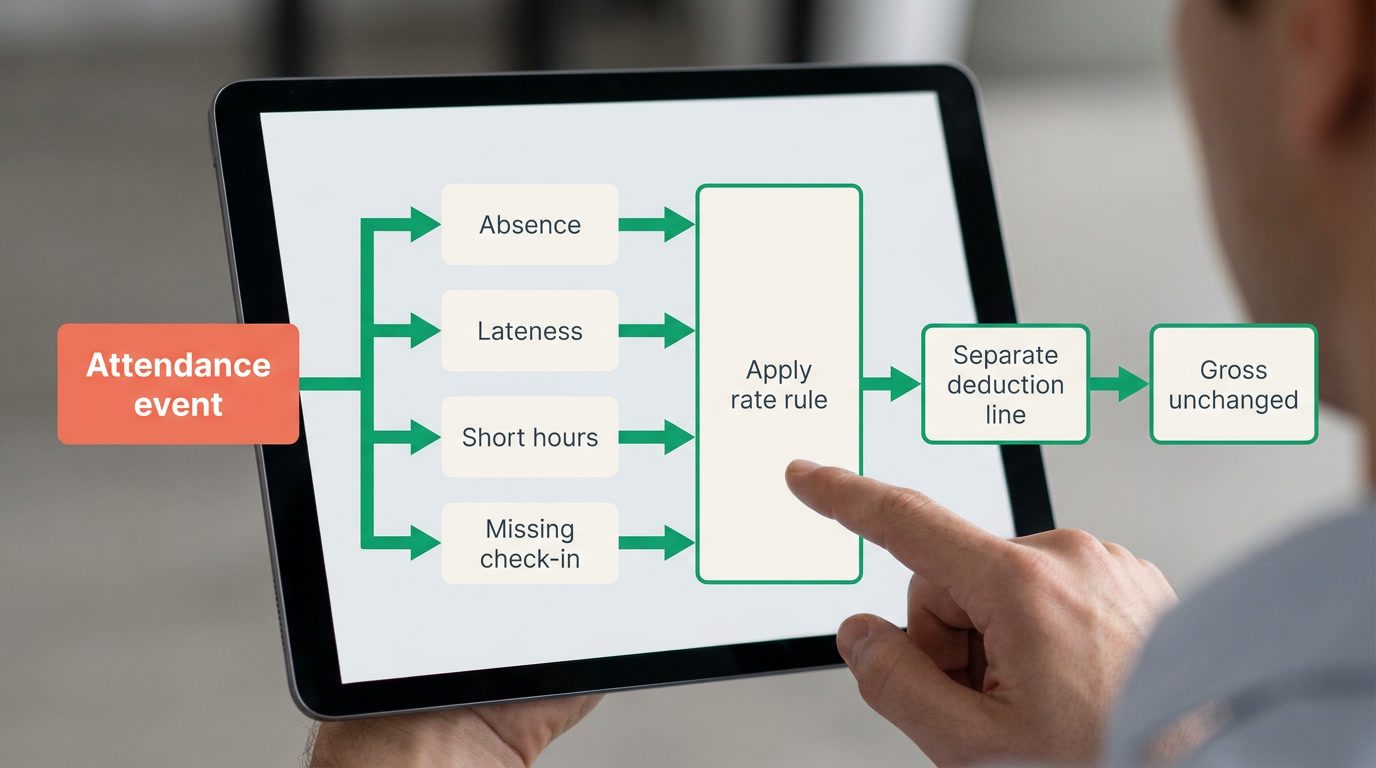
They are pay reductions triggered by an employee's actual time record rather than by a fixed decision. The four common triggers are absence (unauthorised days off), lateness (arriving after the grace window), short hours (working fewer than the scheduled total), and a missing check-in (no attendance record for a worked day). Each is calculated from a rate, not guessed.
The guiding idea is simple: a deduction reflects time that wasn't worked, applied through a written conduct policy everyone can read in advance. A deduction people can predict is a deduction people accept. The opposite — a surprise number at month-end — is how good employees start updating their CVs.
Why should each deduction be a separate line?

Because the alternative — quietly shrinking the basic salary — destroys transparency. If someone loses two days, their gross should still show the full contractual salary, and the two days should appear as a distinct deduction line beneath it. That way the payslip reads as a story: here is what you earn, here is what was taken, and here is why.
- Auditability — a labour inspector, a manager, or the employee can trace every currency unit back to a rule.
- Correct statutory base — income-tax and social-insurance calculations often key off gross; hiding a deduction inside basic can distort the base your country expects.
- Reversibility — if an absence turns out to be an approved sick day, you remove one clean line instead of recomputing the whole salary.
The one rule to remember
Never let an attendance event change the basic or gross figure. Full salary at the top, deductions as their own lines below. If your software forces you to shrink basic to reflect absence, that's a red flag worth raising with the vendor.
How is each type of deduction calculated?
Every attendance deduction starts from a daily rate (monthly salary ÷ the days in your pay period) or an hourly rate (daily rate ÷ scheduled hours). From there, each trigger applies its own rule. The table below shows the standard patterns; the exact divisor and grace windows are policy choices you set, not universal law.
| Deduction type | How it is calculated |
|---|---|
| Absence | Absent days × daily rate. One line per absence block so each is traceable. |
| Lateness | A per-day rule you define: e.g. minutes late × per-minute rate, or a fixed fraction of the daily rate after a grace window. |
| Short hours | (Scheduled hours − actual hours) × hourly rate, summed across the period. Only the deficit is docked. |
| Missing check-in | Treated per policy: often a full-day deduction unless the employee provides an approved correction before the run is approved. |
Notice that lateness and short hours can overlap — someone late by an hour is also short an hour. Decide up front which rule wins so you never double-dock the same minutes. Good software makes that precedence explicit; a spreadsheet almost never does.
What is leave-first absorption, and should you use it?
Leave-first absorption is an optional, kinder setting: before docking pay for an absence, the system draws down the employee's leave balance first, and only deducts cash for whatever the balance can't cover. A one-day absence for someone with leave in hand becomes a leave day, not a pay cut.
It rewards employees who've banked leave and softens honest one-offs, but use it deliberately. Turn it on where you want goodwill; keep it off where absence must carry a real cost. Whichever you choose, the payslip should still show the mechanism — "1 day absorbed from leave, 0 deducted from pay" — so nothing happens in the dark.
The fairest deduction is the one nobody has to ask about, because the payslip already answered the question.
Where should attendance and payroll actually connect?
The deductions above are only as honest as the attendance data feeding them. If time records live in one tool and payroll in another, someone re-types numbers at month-end — and that hand-off is where errors and disputes are born. The fix is to have attendance, leave, and payroll on one system, so the daily rate, the schedule, and the leave balance are the same records the pay run reads.
That single-system idea is where a platform like ERPnBox fits: payroll lives inside the HR app, next to attendance and leave, and connects to the finance ledger — one login, one place where a late check-in and its deduction are the same underlying record. For a wider view of building a salary structure, see HR & payroll; to compare tools sensibly, read how to choose payroll software.
Dedicated payroll specialists such as Gusto are excellent when payroll is your only need and you operate in one country they cover deeply. The trade-off is a separate login and re-keyed data. An all-in-one platform trades a little payroll depth for the thing that kills attendance disputes: one source of truth. Choose by which pain is bigger for you.
See payroll, attendance, and leave on one system
Payroll inside the HR app, connected to attendance, leave, and a real finance ledger — set up with AI, in any language. From $15/user with a 30-day free trial.
Explore HR & payrollFrequently asked questions
Should absence reduce the basic salary shown on the payslip?
No. Keep **basic and gross at the full contractual amount** and show absence as its own deduction line beneath them. This preserves transparency, keeps your statutory base correct, and makes it trivial to reverse a deduction if an absence is later approved as leave.
How do I stop lateness and short-hours rules from double-charging the same minutes?
Set a **precedence rule** in your conduct policy: decide whether lateness or short-hours applies when both would catch the same minutes, and let only one deduct. Software that models this explicitly prevents the double-dock; a manual spreadsheet rarely does.
What is leave-first absorption?
It's an optional setting that **draws an absence from the employee's leave balance before docking any pay**, deducting cash only for what leave can't cover. It rewards banked leave and softens honest one-offs — but the payslip should still show that a day was absorbed from leave rather than paid.
Can I apply a grace period before lateness deductions start?
Yes, and most fair policies do. A **grace window** (say the first few minutes) means minor traffic delays don't cost pay, while sustained lateness still does. Publish the window in the conduct policy so it's a known rule, not a manager's mood.
When are attendance deductions final and hard to reverse?
They should stay editable through the draft and review stages of a pay run and only commit when the run is **approved**. Before that, correcting a missing check-in or an approved leave is a small edit; after disbursement, it usually means an adjustment on the next run instead.
Do I need dedicated payroll software, or is an all-in-one enough?
If payroll is your only need in one deeply-covered country, a dedicated tool like Gusto or ADP is often best. If attendance disputes and re-keyed data are your real pain, an **all-in-one platform** that keeps attendance, leave, and payroll on one system removes the hand-off where errors are born. Match the tool to your bigger problem.