
The short answer
Net-to-gross payroll, or gross-up, means promising an employee a take-home amount and calculating backwards the gross that yields it after tax and statutory deductions. It is iterative because tax depends on the gross you are solving for. The employer absorbs the deductions, so true cost is the full gross plus employer contributions.
Most payroll starts with a gross salary and subtracts from it. Net-to-gross flips the arithmetic. You promise someone a take-home number — the amount that lands in their bank account — and then work backwards to find the gross that produces it after tax and statutory deductions. It sounds simple until you realise the tax depends on the gross you're still trying to find. This guide explains how gross-up works, why it loops, and when a growing business actually needs it.
What does net-to-gross payroll actually mean?
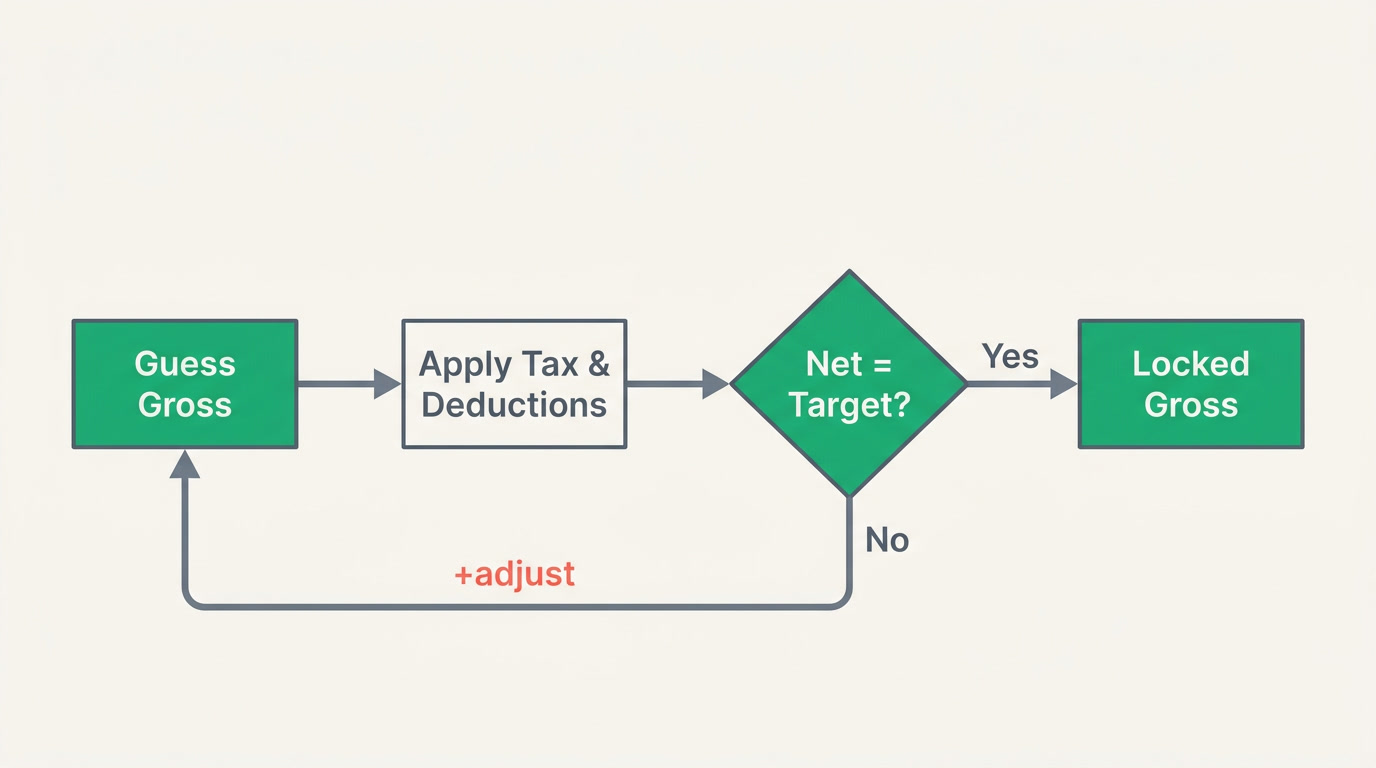
Net-to-gross — often called grossing-up — is the process of calculating the gross salary that will leave an employee with a specific, agreed take-home amount after all deductions. Instead of starting with the gross and subtracting tax, you start with the net the person must receive and solve for the gross. The employer, in effect, absorbs the tax and statutory contributions so the promised figure stays whole.
The everyday model is the reverse. In a gross-first arrangement you agree a gross salary, and the employee's take-home is whatever survives after their country's tax brackets and their share of social insurance. The employee carries the deduction. In net-first, you carry it — which is exactly why it costs the employer more and needs careful budgeting.
Why is gross-up an iterative calculation?

Because tax depends on gross, and gross is the thing you're trying to find — a circular relationship. You cannot compute the tax until you know the gross, and you cannot know the gross until you've accounted for the tax. Software resolves this by guessing a gross, checking the resulting net, and adjusting — repeating until the net matches the promise closely enough.
The loop matters most where tax is progressive. When brackets step up, adding a little gross to cover tax can push earnings into a higher band, which raises the tax again, which means you need a little more gross — and so on. A flat deduction converges in one step; a tiered one may take several passes. This is why grossing-up by hand is error-prone and why good payroll tools do it for you.
A conceptual worked example
Imagine you promise an employee a net of 8,000 a month in your local currency. Suppose, in your jurisdiction, this person faces roughly 20% income tax on the relevant portion plus an employee social-insurance share. If you naively pay 8,000 gross, deductions pull the take-home below 8,000 — the promise breaks. So the software tries a higher gross, say 10,200, checks the net, finds it slightly over or under, and nudges again. After a few passes it settles on the gross — perhaps around 10,400 — that yields exactly 8,000 net. The numbers here are illustrative only; your real figures come from your country's rules.
The hidden cost owners miss
In a net promise, the employer's true cost is the gross plus the employer's own social-insurance share — not the net you quoted. Budgeting off the take-home number understates payroll cost by a wide margin. Always model the full gross before you make a net offer.
Gross-first vs net-first: how do they compare?
The two models answer one question — who absorbs the deductions? In gross-first, the employee does, and the offer is easy to budget because the number you quote is the number you pay before contributions. In net-first, the employer does, the quoted number is protected, and your cost floats with tax rules. Here is the contrast at a glance.
| Aspect | Gross-first | Net-first (gross-up) |
|---|---|---|
| What you agree | A gross salary | A take-home net |
| Who absorbs tax | The employee | The employer |
| Calculation | Subtract, one pass | Iterative, loops until net matches |
| Budgeting | Predictable, quoted = pre-deduction cost | Cost floats with tax; model full gross |
| Employee's view | Take-home varies with tax changes | Take-home stays fixed and clear |
Who uses net-to-gross, and why does it matter?
Net promises are common when the take-home is the clearest thing to agree on — senior hires negotiating on cash-in-hand, cross-border assignments, and one-off bonuses an employer wants to land at a clean number. In each case the person cares about the deposit, not the payslip mechanics, so quoting net removes friction. It matters because it shifts tax risk onto you and reshapes your cost base.
- Budgeting: your true employer cost is gross plus employer contributions — always higher than the net you offered.
- Tax-change risk: if brackets or rates move, the gross needed to hold the net steady moves too, and you absorb the difference.
- Consistency: mixing net-promise and gross-promise staff in one run needs software that computes both without manual spreadsheets.
A practical note on statutory tax: when your payroll withholds income tax, the employer is collecting and remitting on the employee's behalf, not paying the government from its own pocket in a gross-first world. In a net promise you have chosen to shoulder it — a business decision, not a legal default. Keep the two ideas separate when you choose payroll software so you know what your tool is really doing.
What should payroll software do with gross-up?
Good payroll software should run the net-to-gross loop automatically, apply your jurisdiction's brackets and contribution rules, and show both the net promised and the full employer cost side by side. It should let fixed and variable pay, formula-based items like overtime, and a net-target sit in the same run without exporting to a spreadsheet. That is the bar to hold vendors to.
Dedicated payroll specialists such as Gusto, Deel, Rippling, ADP, or Zoho Payroll are strong at deep, country-specific filing and compliance, and if statutory filing in a single market is your whole problem, a dedicated tool is often the honest answer. The trade-off is that payroll then lives apart from your HR records, attendance, and accounting ledger — three systems to reconcile.
The alternative is keeping payroll where the rest of the business already is. On an all-in-one platform, payroll lives inside the HR app — beside employee records, attendance, and leave — and feeds the same double-entry Finance ledger, so a pay run and its cost show up in your books without re-keying. That is how ERPnBox is built: HR and payroll connected to attendance and the ledger on one login, set up with AI assistance, in any language, web and mobile. It is honest to say the baseline payroll — employee records, attendance-linked pay, payslips — is what lives there today; the deepest gross-up and cost-allocation features are the standard to look for, whatever tool you pick.
Quote the net if you must — but never budget from it. Your cost is the gross you had to find, plus the share the law adds on top.
Run payroll where HR, attendance, and your ledger already live
Payroll inside the HR app, connected to attendance and real double-entry Finance on one login. AI helps you set it up, in any language. From $15/user with a 30-day free trial.
Explore HR & payrollFrequently asked questions
What is the difference between net-to-gross and gross-to-net payroll?
Gross-to-net starts with an agreed **gross salary** and subtracts tax and statutory deductions to find the take-home — the employee absorbs the deductions. Net-to-gross starts with a promised **take-home net** and works backwards to the gross that yields it, so the **employer absorbs** the tax. Net-to-gross is iterative because tax depends on the gross being calculated.
Why does grossing up require repeated calculation?
Because tax and the gross salary depend on each other. You need the gross to compute the tax, but you need the tax to know what gross yields the promised net. With **progressive brackets**, adding gross to cover tax can push earnings into a higher band, raising tax again. Software loops — guess, check the net, adjust — until the result matches the target closely enough.
Does a net salary promise cost the employer more?
Yes. When you promise a net figure, you take on the tax and statutory deductions that would otherwise reduce the employee's pay. Your **true cost is the grossed-up salary plus the employer's own social-insurance share** — meaningfully higher than the net you quoted. Budgeting from the take-home number understates payroll cost, so always model the full gross first.
When should a business use net-to-gross payroll?
Use it when the **take-home amount is what both sides agree on** — senior negotiations framed on cash-in-hand, cross-border assignments, or one-off bonuses you want to land at a clean net figure. It removes friction for the employee, who cares about the deposit rather than payslip mechanics. Just remember it shifts tax risk and cost onto the employer.
Can one payroll run mix net-promise and gross-promise employees?
Yes, and good payroll software should handle both in the same run without manual spreadsheets. Gross-first staff are computed by subtraction; net-first staff go through the iterative gross-up loop. The tool applies **your jurisdiction's brackets and contribution rules** to each, and shows the promised net alongside the full employer cost so nothing is hidden.
Do I need a dedicated payroll tool or an all-in-one platform?
If deep statutory filing in a single market is your whole problem, a **dedicated payroll specialist** is often the honest choice. If you want payroll to sit with HR, attendance, and your accounting ledger — so pay runs post to your books without re-keying — an all-in-one platform fits better. ERPnBox keeps payroll inside the HR app, connected to attendance and double-entry Finance on one login.