
The short answer
Payroll cost allocation splits each salary cost across four dimensions — legal entity, department, direct vs indirect, and cost center or product line, stored as employee-by-cost-center percentages. Those splits become a balanced journal voucher that posts labor as expense and net pay, withheld tax, and social insurance as liabilities, plus cost-per-product reports for finance.
Every payroll run ends the same way: money leaves the company and lands in people's bank accounts. But before that happens, a good finance team asks a harder question — not just how much did we pay, but who and what did we pay it for? Payroll cost allocation is the discipline of answering that question in numbers your ledger can read. This guide explains how to split each payroll cost across the dimensions that matter, and how those splits become clean journal entries in a real double-entry ledger.
What is payroll cost allocation?

Payroll cost allocation is the process of assigning each part of your payroll expense to the department, project, product, or cost center that actually caused it — instead of dumping the whole payroll into one "salaries" bucket. It turns a single large number into many small, explainable ones, so accounting knows exactly which slice of the business each dollar of labor belongs to.
Why bother? Because a salary number on its own tells you nothing you can act on. "We spent a lot on payroll" is not a decision. "Delivery is 62% of our labor cost and grew 9% while revenue stayed flat" is a decision. Allocation is what makes payroll a management report instead of a cash-flow shock.
Which dimensions do you split payroll across?
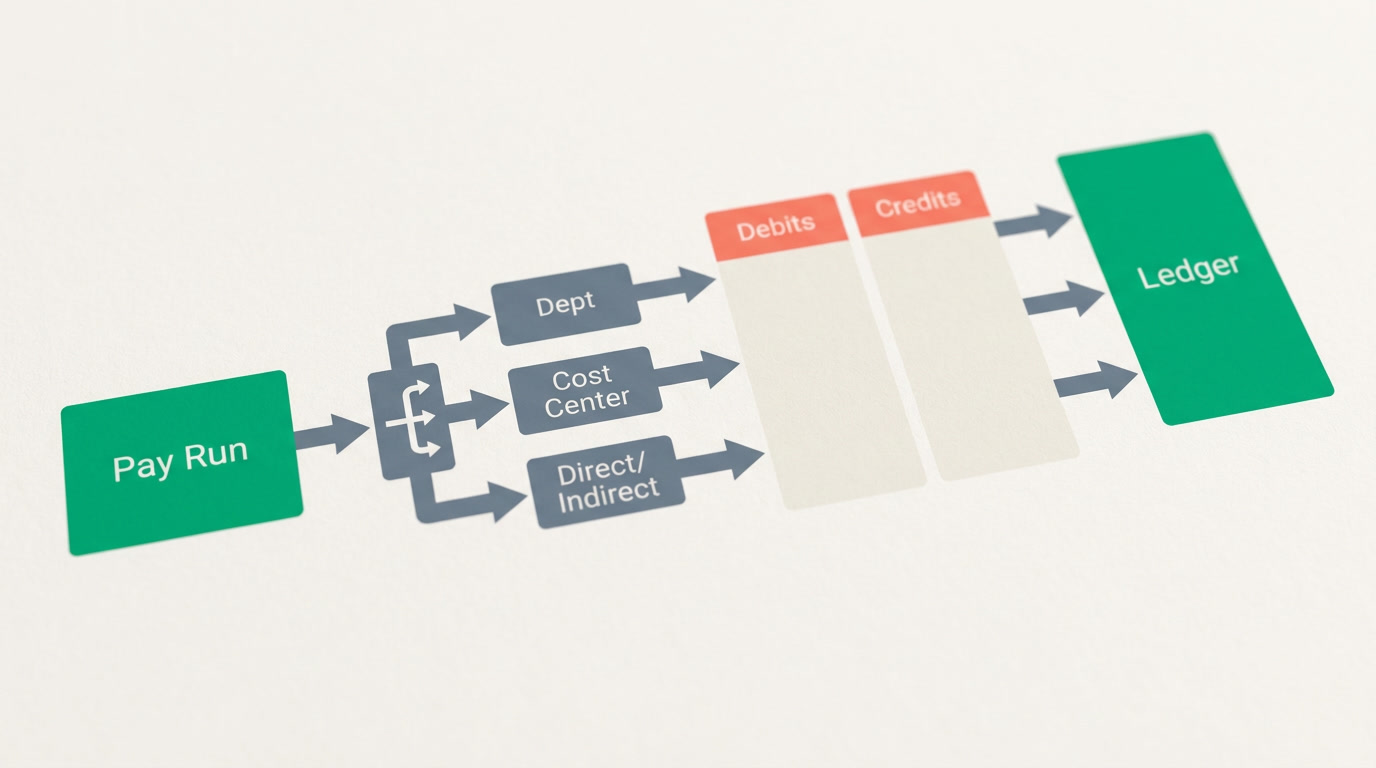
Most businesses allocate payroll across four dimensions: legal entity, department, expense nature (direct vs indirect), and cost center or product line. A single employee can be split across several — say, 70% to one product line and 30% to another — with each slice carrying a percentage. The table below breaks down what each dimension answers and why accounting needs it.
| Dimension | Question it answers | Typical example |
|---|---|---|
| Legal entity | Which registered company bears this cost — critical when a group runs several entities? | A shared employee split 50/50 between two sister companies |
| Department | Which team's budget owns this salary? | Sales, Operations, Finance, Support |
| Direct vs indirect | Is this labor tied to a billable output, or is it overhead? | A line technician (direct) vs an HR manager (indirect) |
| Cost center / product line | Which product, project, or profit center does this labor feed? | Employee × cost center × %, e.g. 60% Product A, 40% Product B |
The percentage is the whole trick
The unit of allocation is employee × cost center × percentage. Store the splits as percentages that sum to 100%, and every pay component — basic, allowances, overtime, employer social-insurance share — inherits the same split automatically. Change one employee's percentages and the whole ledger impact re-derives itself.
How does payroll become a journal voucher?
A journal voucher (JV) is the accounting document that records what a pay run did in debits and credits. Payroll generates it by grouping every allocated cost line by its GL account and dimension, then posting the totals: labor expense accounts are debited, and the amounts owed — net pay, tax withheld, social insurance — are credited to liability accounts until they're paid out.
Here's the part owners often miss: income tax withheld from an employee is not your expense. You are the collector, not the payer. It sits as a liability you owe to the authority until you remit it. Your labor expense is the gross salary plus the employer's own share of statutory contributions — never the employee's withheld tax on top. Good software keeps those lines separate so your books stay honest.
A simplified JV for one pay run might look like this — notice every debit line carries a dimension so it lands in the right cost center:
| Account | Debit | Credit |
|---|---|---|
| Salary expense — Operations / Product A | 12,000 | — |
| Salary expense — Operations / Product B | 8,000 | — |
| Employer social-insurance expense | 2,400 | — |
| Net pay payable (to employees) | — | 17,900 |
| Tax withheld payable (to authority) | — | 1,600 |
| Social insurance payable | — | 2,900 |
The debits and credits balance to the cent — that's the whole point of double-entry. If your payroll tool exports a spreadsheet that accounting has to re-key by hand into the ledger, you've built a bridge with a gap in the middle. Every manual re-entry is a chance to fat-finger a number, and reconciliation swallows a day it shouldn't.
What reports does allocation unlock?
Once every payroll cost carries its dimensions, three reports fall out almost for free: cost-per-product (labor loaded into each product line), cost-per-department (each team's true payroll burden), and the JV itself for the ledger. These are the reports that let finance move from recording the past to steering the future.
- Cost-per-product — labor is often the largest hidden cost in a product's margin. Allocation exposes it so pricing reflects reality.
- Cost-per-department — the input to budgeting and headcount decisions, showing each team's full payroll weight including employer contributions.
- Direct vs indirect labor — the split that gross-margin and manufacturing-cost analysis depend on.
- Entity-level payroll — for groups, a clean per-company view without spreadsheet gymnastics.
Why keep payroll and the ledger on one platform?
Because the bridge between payroll and accounting is exactly where most businesses lose money and hours. When payroll and the ledger live in separate systems, someone exports, reformats, and re-keys every month — and the allocation dimensions rarely survive the trip. When they share one platform, the JV posts itself, dimensions intact, the moment a pay run is approved.
This is the honest case for an all-in-one platform. On ERPnBox, payroll lives inside the HR app — next to employee records, attendance, and leave — and on the same system as a real double-entry Finance ledger. That proximity is the point: the same platform that runs the pay run owns the accounts it posts to. You still design your salary structures, statutory rules, and cost-center splits to match where you operate — no software knows your country's brackets out of the box — but AI-assisted setup helps you configure it from a chat, in any language, on web or mobile. For a deeper primer, see what payroll software actually does and how to choose a payroll system.
None of this replaces good judgment. If your only need is payroll and you operate in a country with a strong dedicated provider — tools like Gusto, Deel, or ADP earn their keep on filings, compliance depth, and local expertise — a specialist may serve you better. The all-in-one case is strongest when payroll is one of several things you're running, and you'd rather they sat on one login, one price, and one ledger than five disconnected apps.
Payroll doesn't end when people get paid. It ends when the ledger knows why they were paid.
Payroll and a real ledger on one platform
See how HR, payroll, attendance, and a double-entry Finance ledger fit on one login — configured from a chat, in any language.
Explore HR & payrollFrequently asked questions
What is a journal voucher in payroll?
A journal voucher (JV) is the accounting entry a pay run produces. It **debits your labor-expense accounts** (grouped by department and cost center) and **credits the liability accounts** for what you owe — net pay to employees, tax withheld to the authority, and social insurance. The debits and credits balance exactly, which is why it slots straight into a double-entry ledger.
How do you allocate one employee across two products?
You store the split as **percentages that sum to 100%** — for example 60% to Product A and 40% to Product B. Every pay component that employee earns, from basic salary to the employer's social-insurance share, inherits that same split automatically. Change the percentages once and the entire ledger impact re-derives itself for the next run.
Is withheld income tax a company expense?
No. Income tax **withheld from an employee is a liability, not an expense** — you are collecting it on the authority's behalf and remitting it later. Your actual labor expense is the gross salary plus the employer's own share of statutory contributions. Keeping these separate is what keeps your books accurate, and no payroll tool files those returns to a government for you — that step is yours.
What's the difference between direct and indirect labor?
**Direct labor** is tied to a billable output — a technician building a product, a consultant on a client project. **Indirect labor** is overhead that supports the whole business — HR, finance, general management. The split feeds gross-margin and cost-of-goods analysis, so allocating it correctly is what lets you see the true labor cost baked into each product.
Do I need one platform, or separate payroll and accounting tools?
It depends on your mix. If payroll is your only need and a strong local provider exists, a **dedicated tool** may serve you better on filings and compliance. If you also run CRM, HR, and accounting, keeping them on one platform means the payroll JV posts itself into the ledger with dimensions intact — no monthly re-keying. Weigh depth against integration honestly.
What does cost-per-product tell me about payroll?
It shows how much **labor is loaded into each product line's margin** — often the largest hidden cost in pricing. Because allocation carries the employee-by-cost-center percentages, the report aggregates every relevant salary, allowance, and employer contribution per product. That's the number that tells you whether a product is actually profitable once the people behind it are counted.