
The short answer
Payroll deductions come in two families: income tax, which the employer withholds from the employee and remits to the state (it is the employee's tax, not the company's), and social-insurance and health contributions, usually split into an employee share and a separate employer cost. Progressive brackets tax only the slice above each threshold. Software calculates all of this every run — but it does not file your returns to a government; that step stays yours.
Every payroll run does two jobs at once. It pays your people, and it acts as a collection agent for the state — pulling income tax and social contributions out of each salary before the money ever reaches an employee's bank account. Get the first job wrong and morale suffers. Get the second wrong and you owe a government arrears, interest, and a conversation nobody enjoys. Statutory deductions are not the company's money and never were — you are holding them in trust and passing them on. This guide explains, without tying itself to any one country's rulebook, what those deductions are, who actually pays them, and the honest line between what payroll software calculates for you and what it will never do on your behalf.
What are payroll tax and statutory deductions?

Payroll tax and statutory deductions are the amounts an employer is legally required to withhold from wages, or to add on top of them, and remit to a government or public fund. The two big families are income-tax withholding (deducted from the employee) and social-insurance and health contributions (usually split between employee and employer). They are mandatory, calculated every pay period, and legally distinct from the salary itself.
The exact rates, brackets, and fund names change entirely from your country's tax authority to the next. What does not change is the shape of the problem: you compute the deduction correctly each run, you keep it separate from take-home pay on the payslip, and you hand it over on time. This universal structure is exactly what payroll systems are built around, which is why good payroll software can serve businesses across borders while the numbers themselves stay local.
What does 'the employer withholds and remits' actually mean?
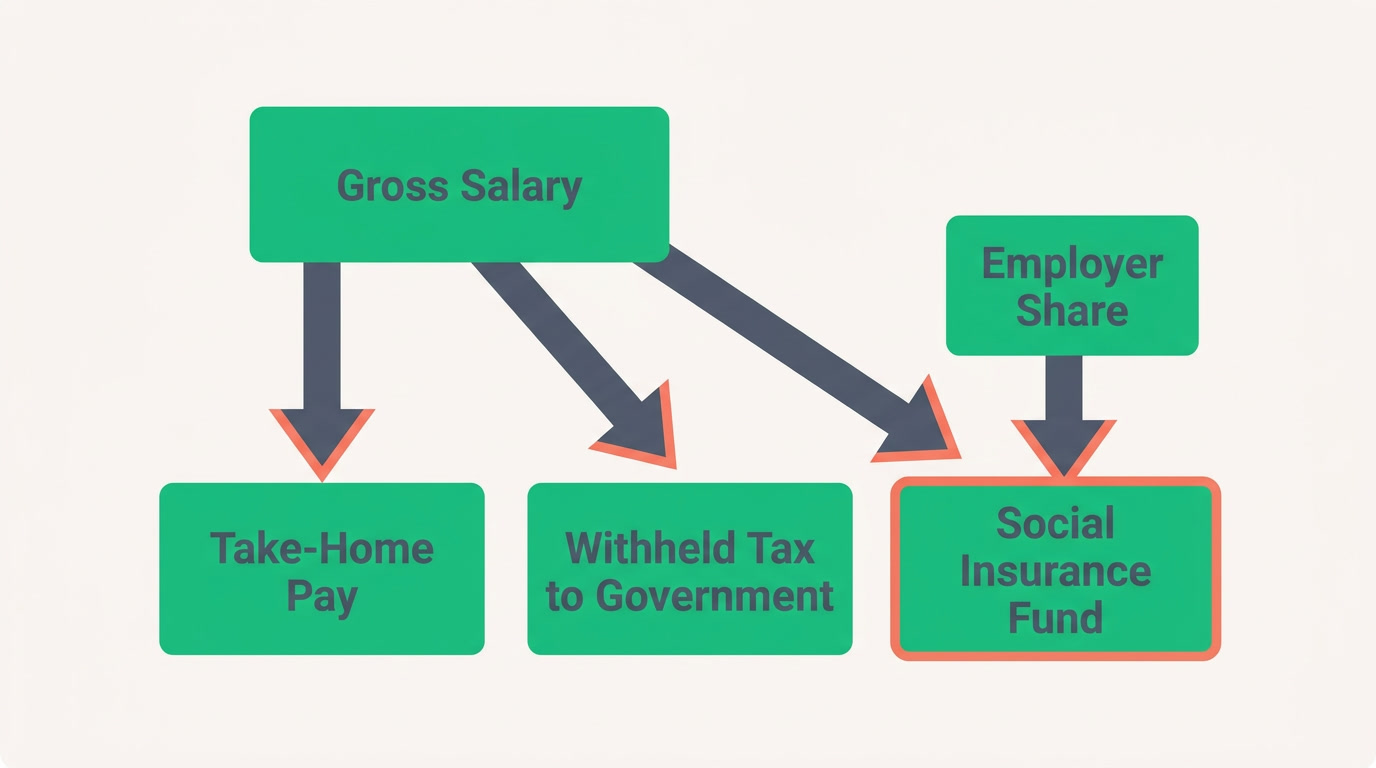
It means the income tax on an employee's salary is the employee's tax, not the company's. The employer simply deducts it at source and forwards it to the authority on the employee's behalf. This is often called withholding or Pay-As-You-Earn. The company is a conduit: the cash flows from employee gross pay, through your payroll, to the government — it is never an expense the business absorbs.
The distinction that trips owners up
Withheld income tax is money you are holding for someone else. It sat inside the employee's gross salary; you took it out and now owe it to the state. Treating that cash as working capital — spending it before you remit — is the single most common way small businesses fall into payroll-tax arrears. Ring-fence it the moment payroll is approved.
How do progressive tax brackets work?
A progressive or marginal tax system taxes different slices of income at rising rates rather than one flat percentage on the whole salary. A first slice may be tax-free, the next slice taxed at a low rate, higher slices at higher rates. Crucially, moving into a higher bracket only taxes the portion above the threshold — not your entire income — so a raise never leaves you with less take-home pay.
Consider a generic three-band example — the numbers are illustrative, not any real jurisdiction's. Someone earning 5,000 a month, where the first 1,000 is exempt, the next 2,000 is taxed at 10%, and everything above 3,000 at 20%, pays tax on each band separately: nothing on the first 1,000, 200 on the next 2,000, and 400 on the top 2,000 — a total of 600, not a flat 20% of the whole 5,000. This banded arithmetic is fiddly by hand and is exactly the kind of rule you want a formula-driven system to apply the same way every single run.
Who pays social-insurance and health contributions?
Usually both sides pay — this is the key difference from income tax. Social-insurance, pension, and health schemes typically carry an employee share deducted from the salary and a separate employer share the company pays on top of the wage bill. The employee share reduces take-home pay; the employer share is a genuine cost to the business, not held in trust. Together they fund pensions, health cover, and unemployment or injury protection where you operate.
Because the employer share is a real expense, it belongs in your accounts as a cost of employment, not just a deduction line. This is where payroll stops being an HR chore and becomes an accounting event — every run should post the wage cost, the employer contributions, and the withheld amounts you owe onward into the general ledger. A platform where payroll sits next to a real Finance ledger closes that loop without a monthly export-and-paste ritual.
Who pays what? A quick reference
The table below separates the three common statutory items by who bears the cost and how the amount is computed each run. Names and rates vary by country; the roles do not. Use it to sanity-check that your payslips keep each line honest and visible.
| Deduction type | Who pays | How it is computed each run |
|---|---|---|
| Income-tax withholding | Employee (employer only collects and remits) | Progressive brackets applied to taxable pay, minus any exemptions and reliefs |
| Social-insurance / pension — employee share | Employee (deducted from salary) | A percentage of an insurable wage base, often capped at a ceiling |
| Social-insurance / pension — employer share | Employer (real company cost, on top of wages) | A separate percentage of the same base, posted as a cost of employment |
| Health / other statutory funds | Often split between employee and employer | Fixed percentage or flat amount per fund rules where you operate |
What does payroll software automate — and what does it NOT do?
Good payroll software calculates the deduction correctly every run — it applies your configured brackets, splits the employee and employer shares, respects ceilings and exemptions, and lists each amount clearly on the payslip. That is the hard, repetitive, error-prone part, and it is exactly what a system should own. But there is a firm limit you must understand honestly: calculating a tax is not the same as filing a return.
A payroll system computes what you owe and produces the reports and journal entries to support it. It does not submit statutory returns to a tax authority or social-insurance fund for you, it does not pay the government on your behalf, and it does not replace an accountant's or lawyer's judgement on local rules. Filing and remittance still happen through your country's official channel — a government portal, a bank transfer, or your accountant — on the deadlines local law sets. Any vendor implying otherwise deserves a hard question or two.
Where ERPnBox fits — honestly
ERPnBox is an all-in-one platform where payroll lives inside the HR app, connected to attendance, leave, and a real double-entry finance ledger on one login. It calculates pay, applies your deductions, and produces payslips in any language, with AI-assisted setup. It does not file your tax returns to a government or pretend to — that step stays yours. When you choose payroll software, keeping HR, payroll, attendance, and the ledger on one system removes the reconciliation gaps between them.
How do you set deductions up without mistakes?
Treat statutory setup as configuration, not code you re-type each run. Enter your brackets, contribution rates, ceilings, and exemptions once as reusable rules, keep every deduction as its own visible payslip line so basic and gross always show the full contractual salary, and let the system re-run the calculation as often as you like before you commit. A reversible pay-run lifecycle — where processing recalculates safely and only approval triggers the real deductions — means a wrong rate is caught in review, not the day after payday.
- Keep withheld tax and employee contributions separate from take-home on every payslip — never net them into an opaque single figure.
- Post the employer share to your ledger as a cost of employment the same period, not as an afterthought at quarter-end.
- Reconcile withheld amounts to what you remit so the trust money you collected always matches the money you paid the state.
- Confirm local deadlines and rates with an accountant — software applies rules faithfully but cannot know when your law changed them.
Payroll software is a superb accountant for the deductions and a hopeless clerk at the tax-office window. Let it do the maths; you still walk to the window.
Run payroll where the numbers already live
Payroll inside the HR app, wired to attendance, leave, and a real finance ledger — in any language, web and mobile. From $15 a user, with a 30-day free trial.
See HR & payrollFrequently asked questions
Is withheld income tax an expense to my business?
No. **Income tax withheld from a salary is the employee's tax, not yours.** It came out of the employee's gross pay; you are only holding it briefly and remitting it to the authority. Treat it as **money held in trust**, not working capital — spending it before you remit is the classic route into payroll-tax arrears.
What is the difference between the employee and employer share?
Income tax is deducted only from the employee. Social-insurance and health schemes usually split into an **employee share** taken out of the salary and an **employer share** the company pays on top of the wage bill. The employee share lowers take-home pay; the **employer share is a genuine cost** to the business and belongs in your accounts as a cost of employment.
Does moving into a higher tax bracket reduce my take-home pay?
No. In a **progressive system the higher rate applies only to the income above the threshold**, not to your whole salary. Each band is taxed at its own rate, so a raise always leaves you with more take-home pay than before — never less. The fear of 'jumping a bracket costing you money' is a common myth.
Will payroll software file my tax returns for me?
Generally no, and be wary of any that claims to universally. Software **calculates the deductions and produces supporting reports**, but submitting statutory returns and remitting the money still happens through your country's official channel — a government portal, bank transfer, or your accountant — on local deadlines. Calculating a tax and filing a return are two different jobs.
Do statutory deduction rates change, and who tracks that?
Yes — brackets, rates, ceilings, and fund rules change when your legislature revises them, and they differ entirely by country. **Software applies whatever rules you configure faithfully, but it cannot know your law changed.** Keep an accountant or local advisor in the loop to update the configured rates, then let the system apply them consistently on every run.
Should statutory deductions show as separate lines on the payslip?
Yes. **Keep each deduction — income tax, employee social-insurance, health — as its own visible line** so the payslip always shows the full contractual gross before anything is taken. Netting them into one opaque figure hides errors, frustrates employees, and makes reconciliation against what you remit far harder than it needs to be.