The short answer
Customers trust an AI agent when they can predict it. Build in six things from the start: tell users it's AI, keep it to a fixed set of actions, offer a human handoff, never invent facts or promises, log every action, and let it touch only what the current user could. Money and irreversible actions should propose-then-confirm, never run unsupervised.
An AI agent that acts inside your business is a strange kind of employee. It never sleeps, it reads faster than anyone on your team, and it will do exactly what you told it to — including the thing you did not mean. The difference between an agent your customers rely on and one they quietly route around is not how clever it is. It is how trustworthy it is. This is a field guide to building the second kind.
Trust is not a feature you add at the end. It is a set of constraints you build in from the first line. Skip them and you get a demo that dazzles and a production system that erodes confidence one wrong answer at a time. Keep them and you get something rarer: a tool people actually let touch their work.
What actually makes customers trust an AI agent?

Customers trust an AI agent when they can predict it. They need to know it is AI, know what it is allowed to do, reach a person when they want one, and believe it will not invent facts or make promises. Predictability, not intelligence, is the currency of trust. Everything below is a way to earn it.
Notice that none of these principles is about the model. A better model does not fix a missing handoff or a nonexistent audit trail. Those are decisions about the system around the agent, and they are where most projects quietly fail. The best way to understand this is to see what breaks when each principle is skipped.
Which trust principles matter, and what happens when you skip them?
Six principles carry most of the weight: be transparent, stay bounded, offer a human handoff, never fabricate, keep an audit log, and respect permissions. Each one is cheap to honor and expensive to ignore. The table below pairs each principle with what it looks like in practice and the specific failure you invite by cutting it.
| Trust principle | What it looks like in practice | Failure if skipped |
|---|---|---|
| Be transparent it's AI | The agent says it's an assistant up front; no fake human name | Customers feel deceived the moment they realize, and none of the good answers count |
| Stay bounded | A fixed list of allowed actions; anything else is refused or escalated | The agent improvises outside its lane and does something no one authorized |
| Offer a human handoff | A visible, one-tap route to a person that carries the context along | Frustrated customers get trapped in a loop and leave angrier than they arrived |
| Never fabricate or guarantee | Answers cite real records; unknowns are admitted, not filled in | One confident wrong promise about a price or a date costs a customer |
| Keep an audit log | Every action the agent takes is recorded with who, what, and when | When something goes wrong you can't tell what happened or reverse it |
| Respect permissions | The agent sees and touches only what the requesting user could | An agent leaks or edits a record the person behind it was never allowed to see |
Why do agents bolted onto generated apps break trust first?
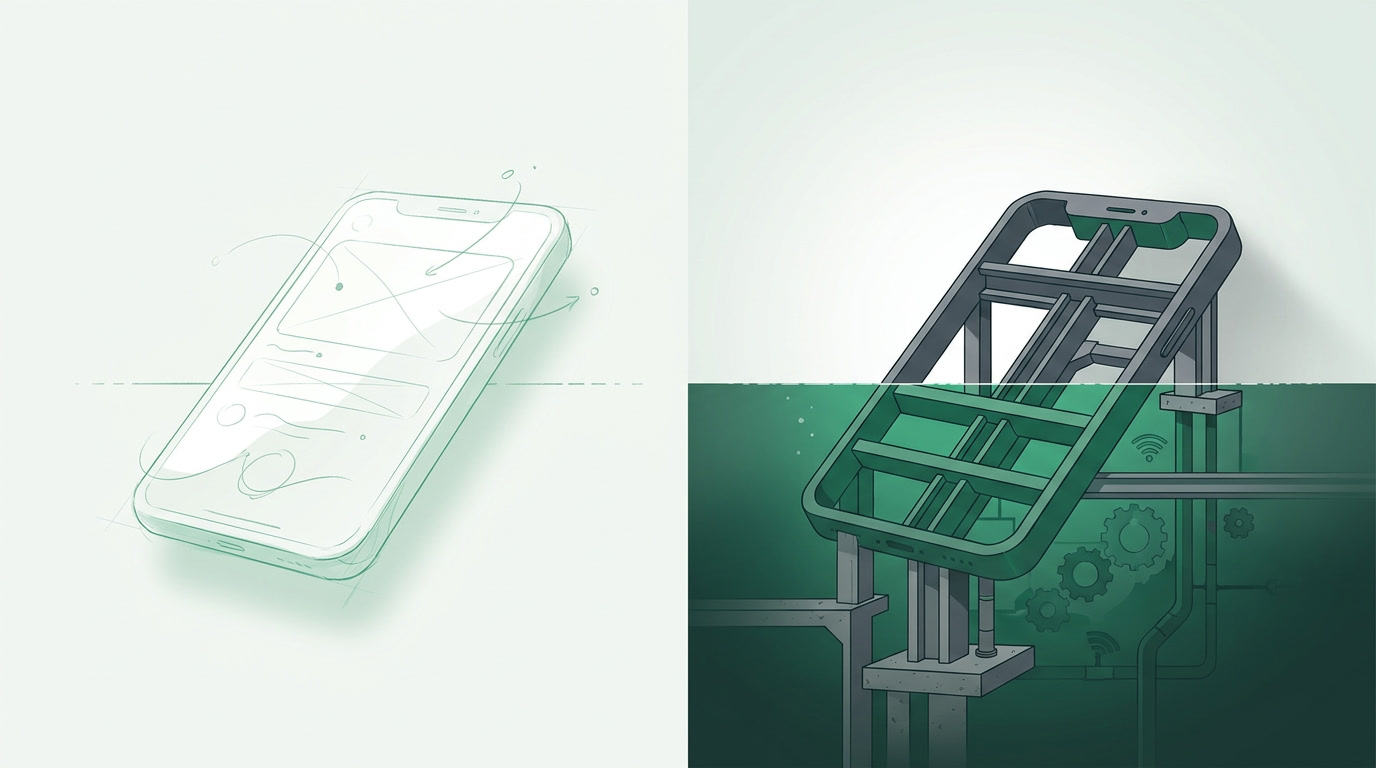
Because the hard parts of trust — permissions, audit, and handoff — live in the platform, not the agent. A quickly generated app usually skips exactly those. It ships a chat box wired straight to the database with naive permissions and no audit, so the agent inherits gaps no one designed on purpose.
This is the honest tension in the whole vibe-coding wave. Generating an app from a prompt is genuinely fast and often good enough to start. But an agent is only as safe as the floor it stands on, and a generated floor rarely has record-level permission checks or a real log underneath it. We've written about this trade-off directly in vibe-coding vs a built platform, and it's worth reading before you point an agent at customer data.
The quiet failure mode
The dangerous permission bug is not the one that throws an error. It's the one where the agent cheerfully returns a record from another team because nobody told it that user couldn't see it. An agent must never touch a record its user couldn't touch — and that check has to live below the agent, not inside its prompt.
How do you keep a helpful agent from overstepping?
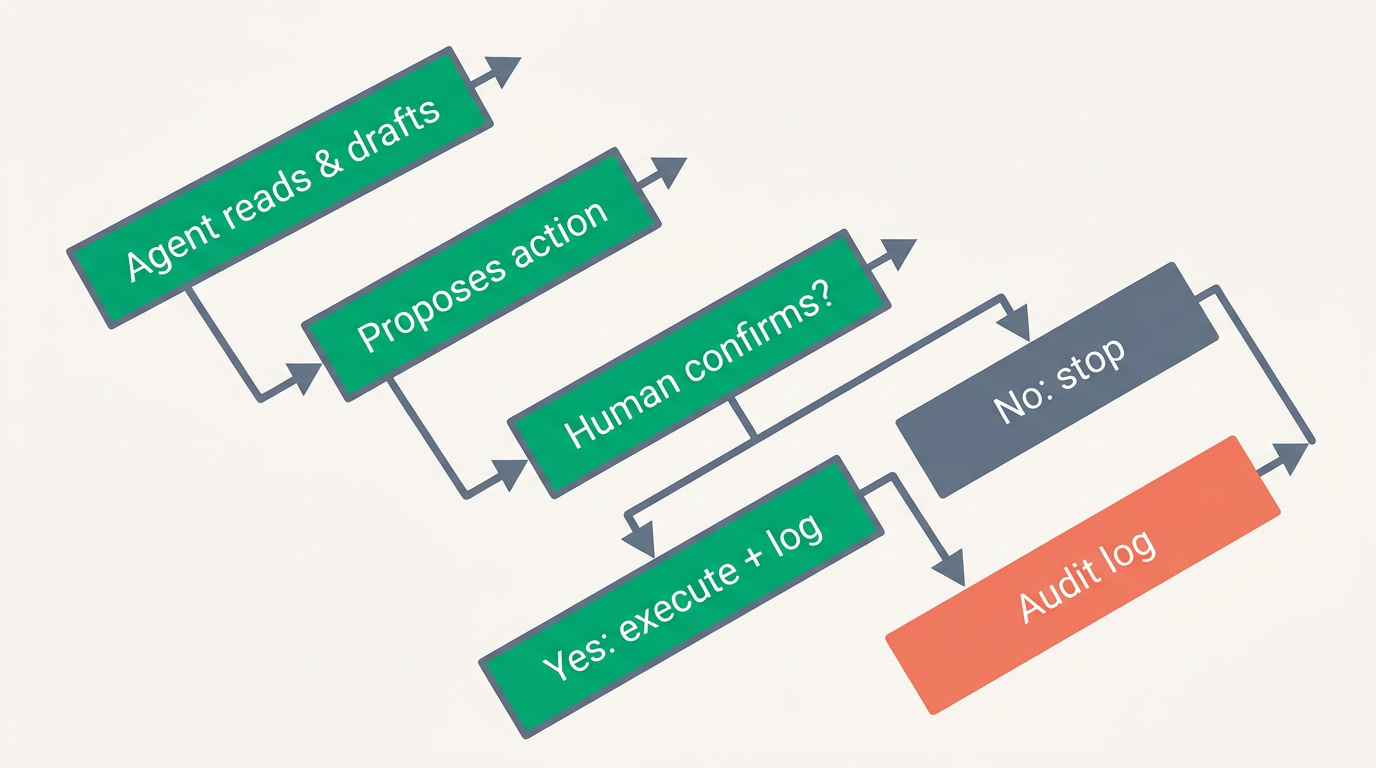
Draw a bright line between reading and acting. Let the agent read, summarize, draft, and suggest freely; require a human confirmation before anything that moves money, changes ownership, or leaves the building. This propose-then-confirm pattern keeps the speed of automation and the judgment of a person exactly where it belongs.
Be honest with yourself and your customers about what the agent is for. A good agent drafts the follow-up email, pulls the numbers, and files the note. It does not forecast your sales, run predictive analytics, or move money on its own while you sleep. Anyone who sells you that last part is selling you a future incident. Frame the agent as an assistant with a clear handoff — never as autopilot for your whole business.
- Read freely, act narrowly. Summaries and drafts need no gate; state changes do.
- Confirm the irreversible. Anything you can't easily undo gets a human tap first.
- Log everything, always. A silent action is one you can't investigate later.
- Inherit the user's permissions, never exceed them. The agent is a tool, not a superuser.
What does a trustworthy agent look like when the plumbing already exists?
It looks calm, because the hard guarantees are handled beneath it. This is the argument for running an agent on a platform where permissions, audit, and human handoff already ship as part of the product — not as things you remember to build. ERPnBox's AI agent works across the apps on exactly that kind of floor.
Because ERPnBox is one connected system — CRM, HR and payroll, real double-entry finance and a dozen apps under one login — the agent reads only what the signed-in person is allowed to read, every action lands in the same audit trail the rest of the platform uses, and a handoff to a human teammate is a native move, not a bolt-on. When it acts on anything sensitive, it proposes and waits for your confirm. You can see how the assistant side of this works on the AI assistant, and how the same chat that runs the workspace first builds it with the AI builder.
The trustworthy agent isn't the one that can do the most. It's the one that always tells you what it's about to do, and stops when you'd want it to stop.
How should you evaluate an agent before you trust it with customers?
Test it against the failure modes, not the happy path. Ask it to do something it shouldn't, ask about a record the current user can't see, and check whether every action left a trace. If it refuses cleanly, escalates to a person, and logs the attempt, it's ready. If it improvises, it isn't.
Run that checklist before launch and again whenever you widen what the agent can do. Trust is not won once; it's maintained. The teams that keep it are the ones who treat every new permission as a small risk to earn back, not a feature to ship and forget. Pair this with your broader workflow automation so the agent's actions and your rules tell the same story.
See an AI agent built on a floor that already trusts safely
Describe your business in a chat and watch the workspace build itself — permissions, audit, and human handoff included. 30-day free trial, no card.
Start building freeFrequently asked questions
Should an AI agent always tell customers it isn't human?
Yes, and up front. The moment a customer realizes they were chatting with a bot dressed as a person, **every good answer it gave loses value** and the deception becomes the story. Disclosing it's an assistant costs nothing and is the cheapest trust you'll ever buy. A clear identity also makes the human handoff feel like a natural next step rather than an admission of failure.
Can an AI agent handle money or approvals on its own?
It shouldn't, and a trustworthy one won't. The safe pattern is **propose-then-confirm**: the agent prepares the invoice, the refund, or the ownership change and a person approves it with one tap. In ERPnBox the agent never runs unsupervised money-moving actions; anything irreversible waits for your confirmation, so speed and judgment stay in balance.
How do I stop an agent from seeing records it shouldn't?
Make the permission check live below the agent, not inside its instructions. The agent should inherit exactly the access of the person who invoked it and never more. ==A prompt that says 'don't show other teams' data' is a suggestion; a permission layer that filters records is a guarantee.== Platforms that already enforce record-level access give the agent this for free; a quickly generated app usually doesn't.
Why does an audit log matter for an AI agent?
Because an agent acts quickly and invisibly, so when something looks wrong you need to reconstruct exactly what it did. A complete **audit log** of who, what, and when turns a mystery into a five-minute review and lets you reverse a mistake with confidence. Without it you're left guessing, and guessing about your own data is where trust dies fastest.
Is it safe to add an AI agent to an app I generated from a prompt?
Only if you've verified the boring guarantees underneath it. Generated apps are great for a fast start but often ship with **naive permissions and no audit trail**, which is exactly what an agent needs and exactly what's missing. Before you connect an agent, confirm record-level access checks and logging exist. If they don't, the agent will amplify whatever gaps the generation left behind.
What's the single most important rule for building an agent customers trust?
Never let it exceed the human behind it. The agent should tell you it's AI, do only what that person is allowed to do, offer a way out to a real teammate, and log every step. If you honor just those, you've covered most of the risk. Everything else — better answers, faster replies — is improvement on top of a foundation that already earns trust.