The short answer
The real ROI of AI at work is not headcount you cut. It is the hours AI frees your team from data entry, chasing, and copy-paste so they can spend that time on judgment, relationships, and closing. Measure AI by the high-value work it enables, and always keep a human in the loop.
For a decade, the return on any workplace tool was measured by subtraction. Buy the system, count the roles it removes, divide the cost. That math made sense for machines that did one thing. It makes far less sense for AI, and if you run a small business, treating AI as a headcount question is the fastest way to buy the wrong thing and waste the promise.
The better question is not how many people you can remove. It is how many hours of your best people you can move — out of the work a machine should never have been doing, and into the work only a person can do.
What is the real ROI of AI at work?
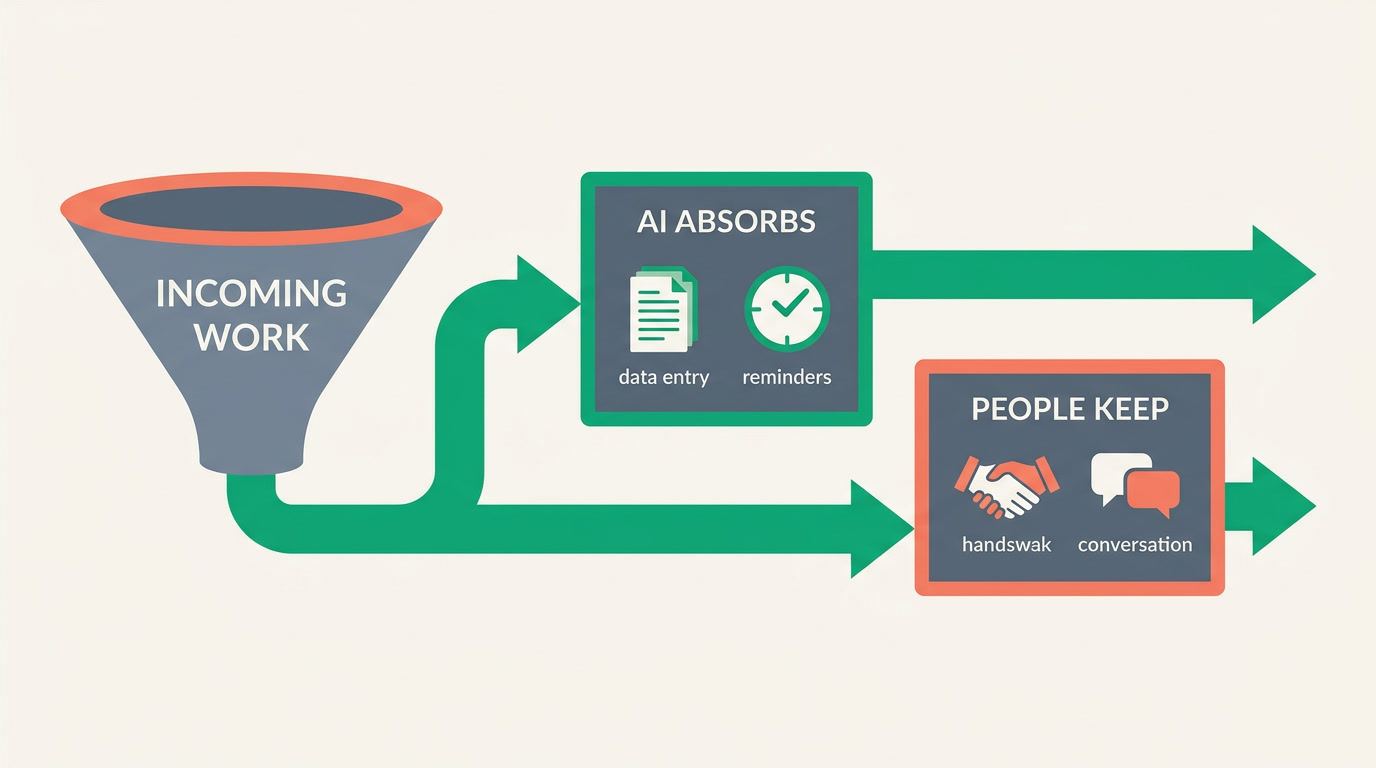
The real ROI of AI is hours reallocated, not people removed. In a small business the gain shows up when a salesperson stops copying records between tools and starts closing, or when an owner stops chasing overdue invoices and starts talking to customers. AI earns its keep by absorbing low-value work so your team can spend more time on the work that actually grows the business.
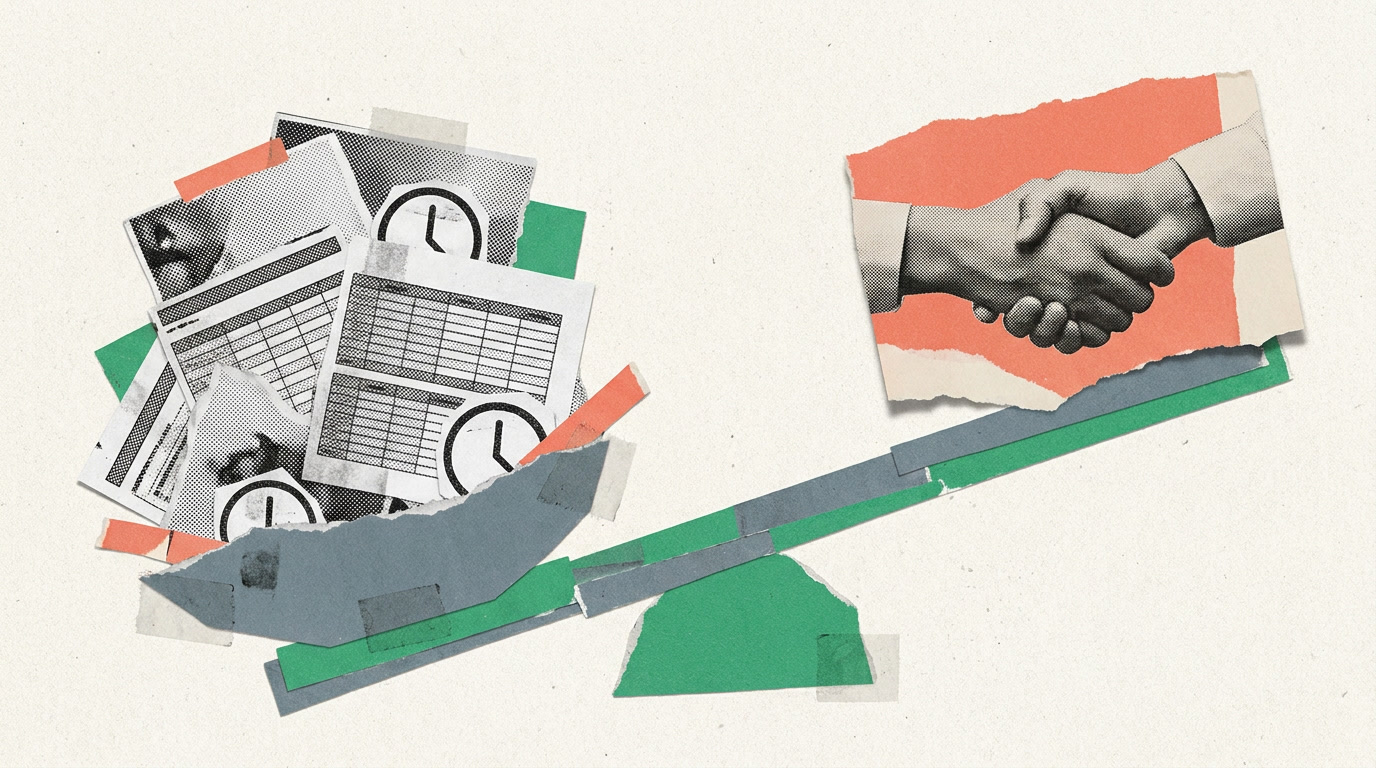
This is a quieter promise than the headlines, and a more honest one. Nobody buys back a whole job. They buy back the twenty minutes here and the hour there that, added across a week, are the difference between a team that reacts and a team that sells. Think of it as a transfer of attention, not a cut in payroll.
Which tasks should AI absorb, and which should people keep?
Draw a clean line. AI is good at the repeatable, the rules-based, and the tedious: entering data, moving it between systems, drafting a first version, chasing a reminder. People are irreplaceable at the ambiguous and the human: reading a room, earning trust, making a call with incomplete information, showing care. Give the first list to the machine and defend the second list for your people.
| Low-value work AI absorbs | High-value work it frees people to do |
|---|---|
| Typing lead details from an email into a system | Reading the buyer and shaping the pitch |
| Copy-pasting numbers between spreadsheet and invoice | Negotiating terms and protecting the margin |
| Chasing reminders for follow-ups and renewals | The actual conversation that keeps the customer |
| Drafting a routine reply or status email | Handling the upset client who needs a person |
| Compiling a weekly numbers summary | Deciding what the numbers mean and what to do |
Notice what the right column has in common. It is all judgment, relationships, and care — the work customers actually pay a premium for, and the work a small team is uniquely good at because it is close to the customer. Automate the left column and you are not shrinking the business; you are pointing it at the things that win.
What does this look like in a real small business?
Concrete beats abstract. Picture a five-person services firm where the founder still sells. Before AI, every new inquiry meant fifteen minutes of typing, routing, and reminders before anyone spoke to the prospect. After, the inquiry lands, is captured and routed on its own, and a follow-up draft is waiting. The founder now spends that time on the call.
- Sales: follow-up automation sends the nudge on time, so the rep only shows up for the conversation that needs a human.
- Finance: an invoice is drafted from the deal it belongs to, so the owner reviews and sends instead of retyping figures.
- HR: a leave request routes to the right approver on its own, so the manager decides rather than shuffles paperwork.
- Support: the routine reply is drafted, so the agent spends the saved minutes on the customer who is actually upset.
You do not measure AI by the desks it empties. You measure it by the calls your people finally have time to make.
Where does AI stop and the human start?
This is the part most vendors skip, so be clear-eyed. AI at work is assistants plus automation with a human in the loop — not a self-running business. Used well, it drafts, routes, captures, and answers questions. It does not make the judgment calls, and you should be suspicious of anyone who says it does.
An honest boundary
AI should draft the email, but you press send. It should flag the overdue account, but a person decides how to handle the relationship. Keep a clear handoff on anything involving money, people, or a customer's trust. The goal is a faster team, not an unsupervised one.
How does ERPnBox turn this into hours back?
Most small teams lose their high-value hours in the gaps between tools — the retyping, the chasing, the copy-paste between a CRM, a spreadsheet, and an inbox. ERPnBox closes those gaps by putting the work in one place: CRM, HR and payroll, real double-entry finance, and a dozen connected apps under one login and one per-seat price.
Because records connect across apps, an invoice carries its deal and a lead routes itself — the copy-paste column of that table simply disappears. On top of that sits the AI: a conversational AI builder that sets up your workspace from a chat (propose, then you confirm), an AI assistant that answers questions and drafts, and an agent that acts across the apps. It is the same human-in-the-loop model this article argues for — built in, not bolted on.
You do not need an implementation project to get there. Set up the workspace by describing your business, let workflow automation handle the routing and reminders, and keep your people on the calls, the closes, and the care. That is the ROI worth measuring.
See what your team could do with the hours back
Describe your business and watch the workspace build itself. 30-day free trial, no card required.
Build your workspaceFrequently asked questions
Does AI ROI mean I should reduce my team?
Not necessarily. The clearest return in a small business comes from **redirecting hours**, not removing people. When AI absorbs data entry and chasing, your existing team gets more time for selling, serving, and deciding — which usually grows the business faster than a smaller payroll would save.
How do I measure the return if it is not headcount?
Track **hours moved** from low-value to high-value work, and the outcomes that follow: more follow-ups completed on time, faster invoicing, shorter response times, more deals closed per rep. Those are the signals that saved minutes became better results.
Can AI run parts of my business without me?
It can automate routing, reminders, capture, and first drafts, and it can answer questions across your apps. It should not make final calls on money, people, or customer trust. Keep a **human in the loop** with a clear handoff — the goal is a faster team, not an unsupervised one.
What kinds of work should always stay with people?
Anything that needs judgment, empathy, or trust: reading a buyer, negotiating, handling an upset customer, deciding what the numbers mean, and making a call with incomplete information. Those are the tasks customers pay a premium for and where a close-knit small team wins.
How does an all-in-one system change the AI math?
Much low-value work is copy-paste between disconnected tools. When CRM, finance, and HR share one place, that work vanishes and the AI has full context to draft and route accurately. An all-in-one setup like [ERPnBox](/features) removes the gaps that create busywork in the first place.
Do I need a big implementation project to start?
No. With a conversational [AI builder](/features/ai-builder) you describe your business in a chat and the workspace is proposed for you to confirm, usually in minutes. You can start on a 30-day free trial with no card and see the hours come back before committing.