
The short answer
Becoming agentic means routine work runs end-to-end while people supervise. Do it in stages: map the repetitive work, get your data in one place, add rule-based automations, add AI assistants for drafting and answers, then add a bounded agent you confirm. Measure results and keep a human in the loop.
"Agentic enterprise" sounds like something that needs a task force, a consultant, and a year. It doesn't. Stripped of the conference-stage language, becoming agentic just means letting software handle the routine work while people keep the judgment. A small business can start this week, in stages, without hiring anyone to build a platform.
What does it actually mean for a small business to be agentic?
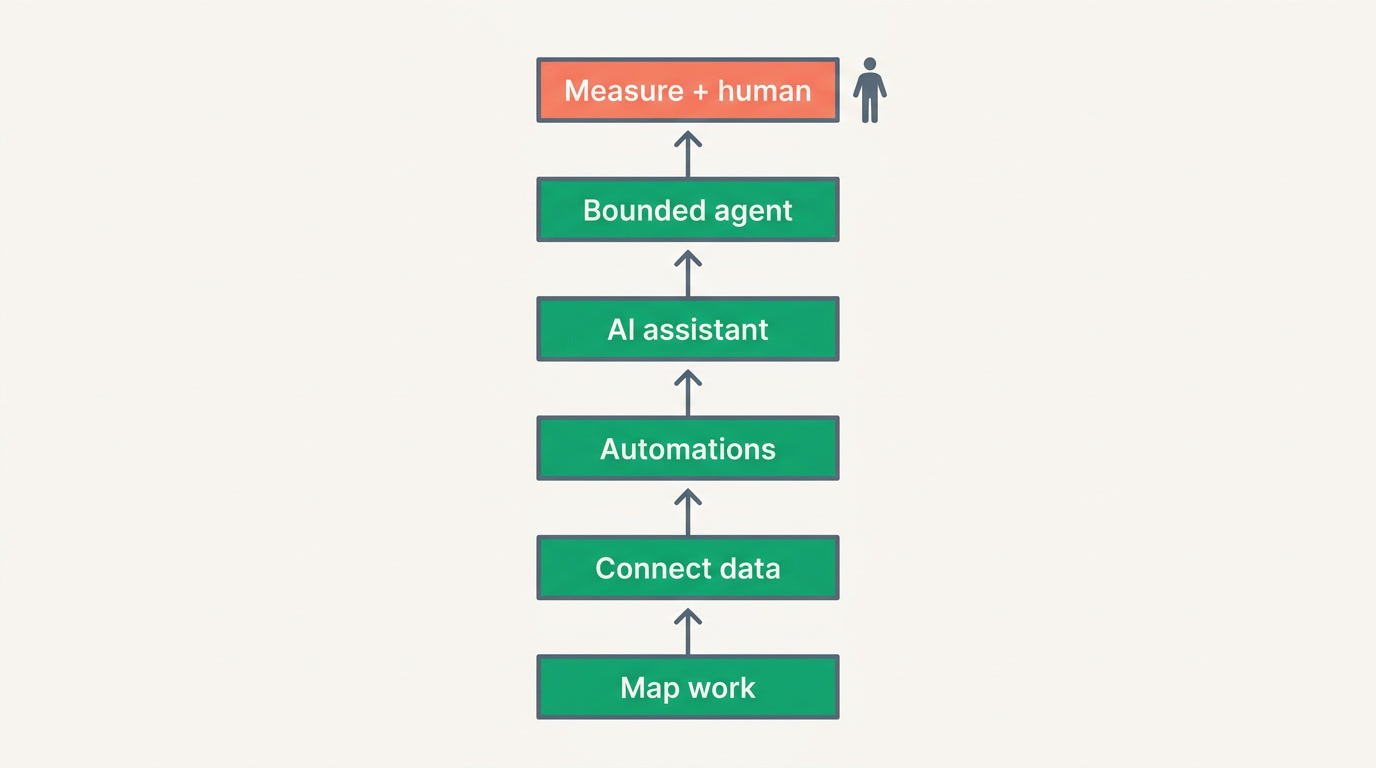
Being agentic means routine work runs end-to-end with a human supervising, not tapping every key. Automations move things along on rules; assistants draft and answer; a bounded agent takes small multi-step actions you confirm. You keep the judgment; software takes the repetition. It changes who does the boring parts, not who is in charge.
The honest framing matters. This is crawl, walk, run — not overnight autonomy. The businesses that get burned hand a machine the keys and walk away. The ones that win add capability one layer at a time and never let money move without a person saying yes.
Where should you start before touching any AI?
Start by mapping the repetitive work — the tasks people do the same way every week. For one week, have the team jot down anything they type twice, copy between tools, or chase by hand. That list, not a fancy tool, is your roadmap. The most-repeated, lowest-judgment tasks are your first candidates.
Look for the tells: the same email sent after every sale, the follow-up that slips because someone was busy, the spreadsheet updated by hand each Friday. These are the seams where routine work leaks time. You are not automating a job; you are automating a motion.
Why is connected data the real prerequisite?
Because an agent can only act on records it can see and follow. If your leads live in one tool, invoices in another, and staff details in a third, any assistant is working half-blind. Before automation earns its keep, your customer, deal, invoice, and employee records need to live in one connected place. This is the unglamorous step that makes the rest possible.
This is where the all-in-one versus best-of-breed decision bites. A drawer of specialist tools each does its job well, but the connective tissue — the wiring that lets an invoice know which deal it came from — is left for you to build and maintain. When records are already connected, a follow-up rule or a bounded agent has something coherent to act on.
What are the six steps to becoming agentic?
There are six, in order, and the order is the point. Each step earns trust for the next. Skip ahead — say, to an autonomous agent before your data is connected — and you build on sand. Move to the next layer only when the current one is boringly reliable.
- Map the repetitive work. One week of noting every task done twice. This is your backlog.
- Get your data in one place. Connected records are the fuel; without them, nothing downstream is safe to automate.
- Start with automations. Simple rules and workflow automation: when a lead comes in, route it; when a deal closes, create the invoice.
- Add AI assistants for drafting and answers — the AI assistant writes the reply, summarizes the thread, answers "what's overdue?" A person still hits send.
- Add a bounded agent with human confirm. Let it string a few steps together — draft, update, schedule — and pause for your yes before anything leaves the building.
- Measure and keep a human in the loop. Track what the automation saved and where it erred; adjust. Nothing runs unsupervised, and no money moves on its own.
The line you never cross
An agent can prepare a payment, draft a refund, or line up a payout. It should never execute a money move unsupervised. Keep the final click human. This is not timidity — it is how you keep speed without handing over the checkbook.
Which stage automates what, and what stays human?
Use this as a decision table. Read left to right: at each stage, what software takes on, and what the human still owns. The human column never empties — it just moves up the value chain, from typing toward deciding.
| Stage | What software automates | The human's role |
|---|---|---|
| Automations (rules) | Routing leads, creating invoices from deals, reminders, status changes | Set the rules; review exceptions |
| AI assistant | Drafting emails, summarizing, answering questions on your data | Edit and approve; hit send |
| Bounded agent | Multi-step tasks across apps: draft, update record, schedule | Confirm the plan before it acts |
| Money & judgment | Prepares figures, drafts payouts and refunds | Always decides and executes payments |
Do you really need a platform team to pull this off?
No — and that is the honest reframe. Large enterprises build agentic setups with engineers stitching tools together. A small business can't and shouldn't. What lowers the bar is having connected data, workflows, and an agent already in one place, so the wiring is done and you spend your time on the six steps, not on plumbing.
This is where ERPnBox fits the picture honestly. You describe your business in plain language and the AI builder proposes the modules, fields, and workflows — propose-then-confirm, so you approve before anything is built. Records connect across CRM, HR and payroll, and real double-entry Finance: a lead auto-routes, and the invoice it becomes carries its deal. An AI agent works across those apps, and an assistant drafts and answers — all with a human in the loop.
Be clear about the ceiling, because honesty is the whole point of a guide like this. The AI builds and runs the workspace, drafts, and takes bounded actions you confirm. It does not replace your judgment, forecast your sales, or run predictive analytics, and it will not move money on its own. Treat it as capable assistants plus automation with a clear handoff — never as a business you can set and forget.
The goal is not a business that runs itself. It is a business where the owner spends the day deciding, not typing.
How do you know it's actually working?
Measure the thing you set out to fix. Before you automate a motion, note how long it takes and how often it slips. After, watch the same numbers. Teams consistently find that the wins are boring and real: fewer dropped follow-ups, invoices out the same day, less Friday-afternoon spreadsheet dread. If a layer isn't paying off, roll it back — agentic is a dial, not a switch.
Take the first two steps this week
Describe your business in plain language and watch a connected workspace propose itself — CRM, HR, and Finance in one login. 30-day free trial, no card.
Start building freeFrequently asked questions
Is "agentic business" just a rebranded automation?
Not quite. Automation follows fixed rules; an **agent strings several steps together** and adapts within limits — drafting, updating a record, then scheduling, for example. Agentic work is the whole ladder: rules at the bottom, assistants in the middle, a bounded agent on top, ==with a human confirming the meaningful moves==.
Can AI run my business on its own?
No, and be wary of anyone who says it can. Today's AI **drafts, answers, and takes bounded actions you confirm**. It does not replace your judgment, forecast sales, or move money unsupervised. The reliable model is capable assistants plus automation with a **human in the loop** — not set-and-forget.
What's the single most important first step?
Getting your data in one connected place. It sounds dull, but **an agent can only act on records it can see and follow**. If leads, invoices, and staff details live in separate tools, every layer above is working half-blind. Connect the records first; automate second.
Do I need engineers or a platform team?
No. That's the enterprise version of the story. For a small business, what lowers the bar is having **connected data, workflows, and an agent in one place already** — so the wiring is done for you. You spend your effort on the six steps, not on stitching tools together or maintaining integrations.
How fast can a small team see results?
The first two layers — rules and an assistant — usually pay off within days, because they target work you already do daily. The bounded agent takes longer, since you'll want to watch it and tune its limits. **Crawl, walk, run**: don't rush to the top of the ladder before the lower rungs are boringly reliable.
Will an agent ever pay a bill or issue a refund by itself?
It shouldn't. A good setup lets an agent **prepare** a payment or **draft** a refund and then stop for a person to approve. Keeping the final click human is how you get speed without handing over the checkbook. Never allow **unsupervised money moves**, however trustworthy the automation feels.