The short answer
A sales playbook is the written, repeatable account of how your team sells: ideal customer, pipeline stages, qualification, messaging, follow-up cadence, handoff, and metrics. Write each section short and example-heavy, then move it into your CRM as stages and automations so the whole team follows it by default rather than reading a document.
Every business already has a sales process. The trouble is that it usually lives in one person's head, shifts with their mood, and walks out the door the day they leave. A sales playbook is the fix: the written, repeatable account of how your team wins business, from the first hello to the signed order. This guide shows how to build your own, with example checklists and cadences you can copy today, and then how to make it something people actually follow instead of a document nobody opens.
What exactly is a sales playbook?

A sales playbook is a single document that describes how your company sells: who you sell to, the stages a deal moves through, how you qualify, what you say, how often you follow up, and how you measure it. Think of it as the recipe, not the meal. A good playbook makes an average rep behave like your best one on an ordinary Tuesday.
It is not a script to be read robotically, and it is not a policy manual. The best playbooks are short, opinionated, and full of real examples. If your version reads like a legal contract, nobody will use it. The seven sections below are the ones every playbook needs, whether you sell software or scaffolding.
- Ideal customer profile (ICP) — the accounts and people worth your time.
- Pipeline stages — the named steps a deal passes through.
- Qualification — the checklist that tells a real deal from a time-sink.
- Messaging and templates — what to say at each step.
- Follow-up cadence — how and when you chase.
- Handoff — how a deal moves to onboarding or delivery.
- Metrics — the few numbers that tell you it is working.
How do you define your ideal customer and stages?
Start by writing down who your best current customers actually are, then describe the next hundred like them. A useful ICP is specific: company size, industry, the trigger that makes them buy, and the job title who signs. Vague ICPs ("small businesses that want to grow") let reps chase anyone, which is the same as chasing no one.
Then name your stages after what the buyer has done, not what you hope. "Sent proposal" is a stage; "interested" is a feeling. Most small teams need only five to seven stages. Keep them so clear that two reps would drag the same deal to the same column. Here is a starter set you can adapt.
- New lead — captured, not yet contacted.
- Contacted — a real two-way conversation has happened.
- Qualified — passed your checklist; a genuine fit.
- Proposal sent — pricing is in their hands.
- Negotiation — terms and objections on the table.
- Won / Lost — decided, with a reason recorded.
What should your qualification and discovery look like?
Qualification is the part that saves the most time, because the cheapest deal to lose is the one you never should have chased. Write a short checklist a rep can answer in the first call. If two or more answers are "no," the deal is not qualified yet. Below is an example you can lift and edit.
Example: a five-point qualification checklist
1. Do they have the problem we solve, in words, not guesses? 2. Is there a budget range they can name? 3. Are we talking to someone who can say yes, or a path to them? 4. Is there a timeline — an event forcing a decision? 5. Are we a genuine fit versus their alternatives? Three or more clear "yes" answers means qualify and advance the stage.
Discovery is how you earn those answers without an interrogation. Keep a fixed question set so every rep uncovers the same essentials, then improvises around them. Learn more about qualifying and nurturing in what is CRM. A workable discovery set looks like this:
- "Walk me through how you handle this today — what breaks?"
- "What made you look for a change now, rather than last year?"
- "If this stayed unsolved for another year, what would it cost you?"
- "Besides you, who else needs to be comfortable with this decision?"
- "What would make this an easy yes for you?"
How often should you follow up, and with what?
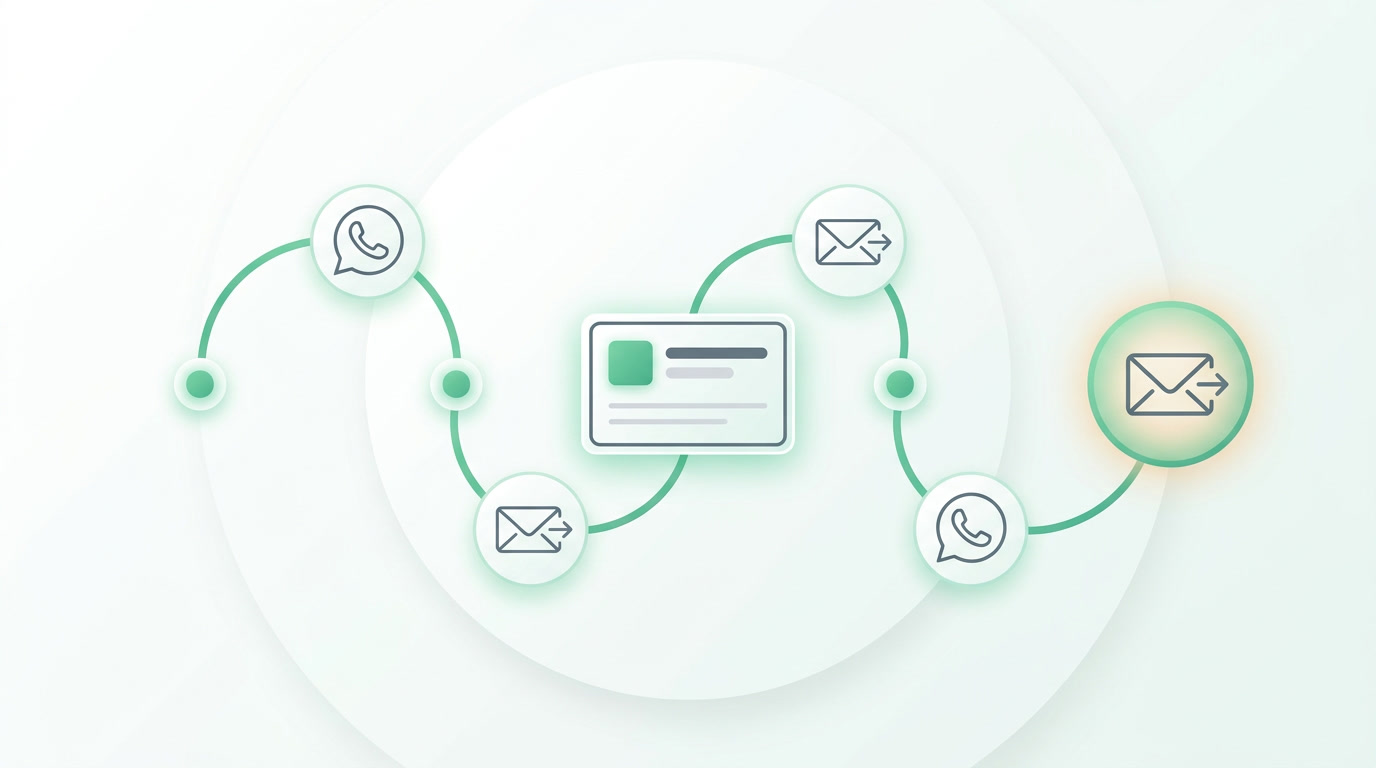
Most deals are lost to silence, not to a competitor. Teams consistently find that the majority of sales require several follow-ups, yet most reps stop after one or two. Your playbook should remove that decision from the rep entirely by spelling out a default cadence — a schedule of touches with a purpose for each. Here is an example for a warm inbound lead.
| Day | Channel | Purpose of the touch |
|---|---|---|
| Day 0 | Call + email | Respond within minutes; book a discovery call. |
| Day 2 | Send one relevant example or case, no pitch. | |
| Day 4 | Call | Short check-in; answer the obvious first objection. |
| Day 7 | Share pricing or a proposal if qualified. | |
| Day 12 | Call + email | "Should I close your file?" — the honest breakup. |
Notice each touch has a job to do; it is not "just checking in." You can go deeper on rhythm, timing and templates in our guide to sales follow-up automation. Write your cadence once, and every new hire inherits your best salesperson's persistence on day one.
Why does a playbook fail as a document but work in a CRM?
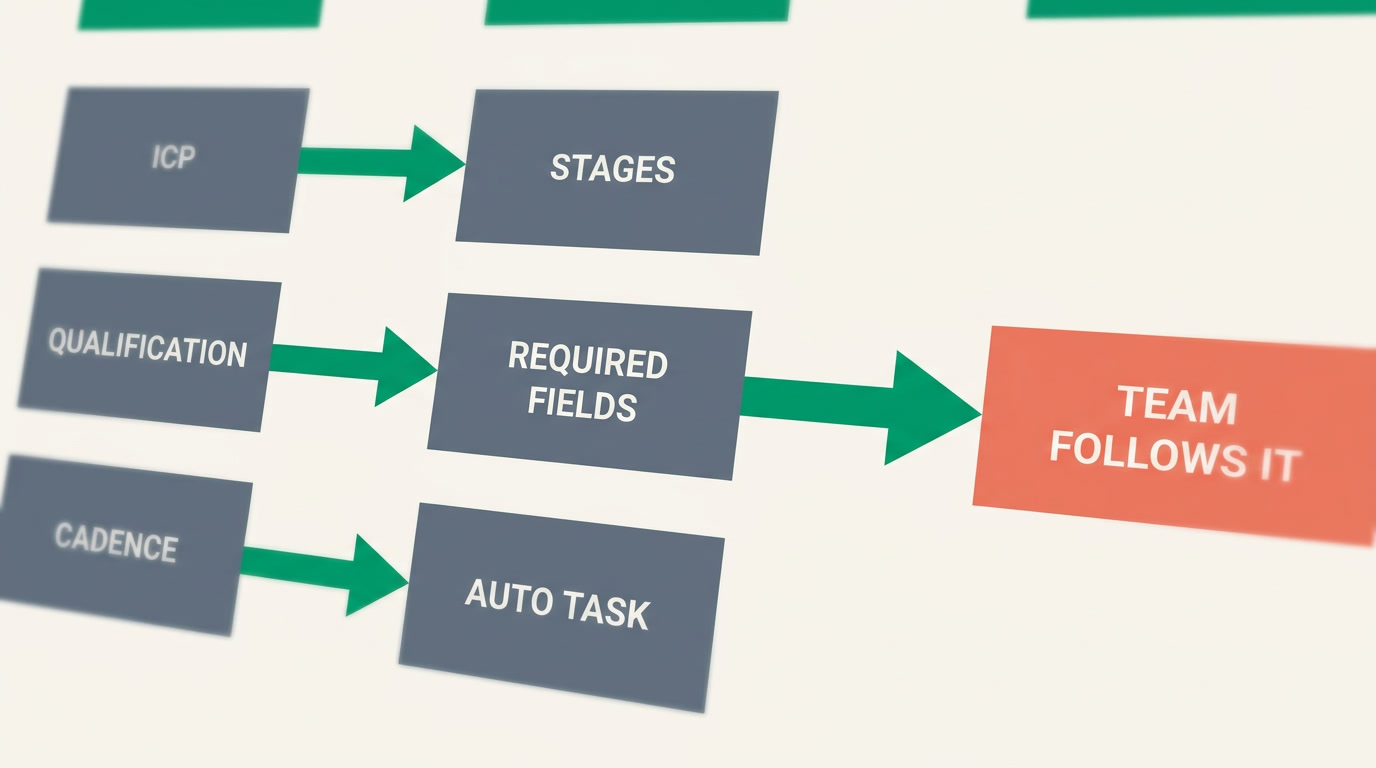
A written playbook is read once and forgotten. The same rules, built into a CRM, become the path of least resistance: stages are columns, qualification is a required field, the follow-up is a task that appears on its own. The playbook stops being something you remember and becomes the way the tool already works. That is the difference between a binder and a habit.
| Playbook section | What you write | How the CRM enforces it |
|---|---|---|
| Ideal customer | Fit criteria and disqualifiers | Fields and views that surface only fitting leads |
| Pipeline stages | Named steps a deal moves through | Stages become the board every deal lives on |
| Qualification | Your yes/no checklist | Required fields block advancing an unqualified deal |
| Follow-up cadence | Timed touches with a purpose | Automation creates each task and reminder on time |
| Assignment | Who owns which lead | Rules route each new lead to the right rep instantly |
| Response time | How fast we reply | An SLA flags anything left too long |
How does ERPnBox make the playbook run itself?
This is where a tool built for small teams earns its keep. In ERPnBox, your written playbook becomes the working system: pipeline stages you define, assignment rules that route each new lead to the right owner the moment it arrives, follow-up automation that creates the next task on schedule, and an SLA that quietly flags a deal nobody has touched. You describe how you want to sell in plain language, and the AI builder proposes the stages, fields and workflows for you to confirm.
The honest part: the tool does the routing, reminding and drafting, but the judgment stays with your people. The AI will draft a follow-up email or answer a question about a deal through the AI assistant; it will not decide who to trust or when to walk away. Because a lead, its deal, and eventually its invoice all live under one login, a won deal carries its history straight into your books — no re-typing, no lost context. That is one workspace instead of five, at one per-seat price.
A playbook nobody follows is a wish. A playbook built into the stages, rules and reminders your team already uses is simply how the work gets done.
See your playbook come to life
Describe how you sell in plain words and watch ERPnBox lay out your stages, rules and follow-ups. Free for 30 days, no card required.
Start freeFrequently asked questions
What is the difference between a sales process and a sales playbook?
A **sales process** is the sequence of stages a deal passes through. A **sales playbook** is the fuller document around it — the ideal customer, qualification checklist, messaging, follow-up cadence, handoff and metrics — that explains not just the steps but how to run them well. The process is the skeleton; the playbook is the whole body.
How long should a sales playbook be?
Short enough that a new hire reads it in one sitting — often a handful of pages, not a manual. Favour examples, checklists and templates over prose. If a section cannot fit on one page, it is probably two sections. You can always deepen it later; a lean playbook that gets used beats a thorough one that gathers dust.
How do I get my team to actually use the playbook?
Do not rely on memory. Build the playbook into the tool your team lives in: stages become the board, qualification becomes a required field, and the follow-up becomes a task that appears on its own. When the right action is also the easiest action, adoption stops being a training problem and becomes the default path.
Can AI write my sales playbook for me?
AI can draft a strong first version and set up the stages, fields and follow-ups to match — in ERPnBox it proposes them for you to confirm. But the ideal customer, the real objections and the reason you win are yours to supply. Treat AI as a fast assistant that turns your knowledge into a working system, not as a substitute for knowing your buyer.
How many pipeline stages should a small business use?
Usually five to seven. Fewer, and you cannot see where deals stall; more, and reps argue over which column a deal belongs in. Name each stage after a buyer action you can verify — "proposal sent," not "warm" — so any two people would place the same deal in the same place. Add stages only when you feel a real blind spot.
What metrics belong in a sales playbook?
Keep it to a few you will genuinely watch: conversion rate between stages, average time in each stage, follow-ups per deal, and win rate by lead source. These tell you where deals leak and which stage needs coaching. Avoid vanity counts; a metric earns its place only if it would change a decision you make this month.